
Hsl 150eq Telescope Review of 2026 for Deep-Sky Views
Explore our November 2026 hsl 150eq telescope review to see how this 150mm reflector delivers bright lunar details and steady planetary tracking.
 By John Snow
Updated September 28, 2026
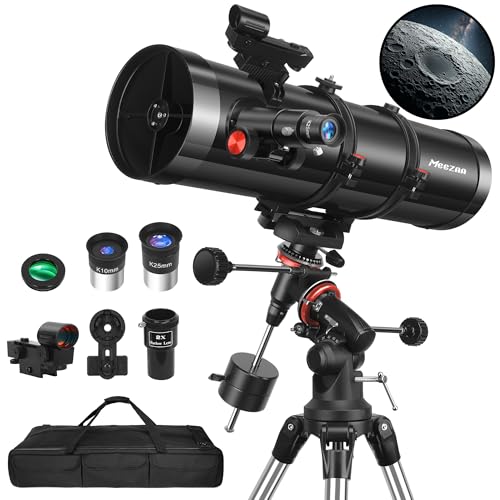

Clear Lunar Vistas and Stargazing Aperture
Shaky tripod legs and narrow optical tubes often turn backyard stargazing into an exercise in pure frustration. Small lenses struggle to pull in faint photons from deep-sky nebulae, leaving viewers with dim, fuzzy smudges. Optical light-gathering power matters far more than empty magnification numbers printed on retail boxes. Readers evaluating an upgrade frequently search for an hsl 150eq telescope review to learn whether a six-inch reflector on an equatorial mount provides genuine celestial performance. A fast focal ratio combined with a generous primary mirror helps resolve subtle cloud bands on Jupiter while pulling open star clusters out of suburban light pollution.
Balancing optical tube weight with mount stability remains essential for smooth night sky sessions. The German equatorial mount requires initial polar alignment, yet manual slow-motion cables make centering moving targets effortless once locked into position. Pairing generous light throughput with quality telescope accessories can unlock rewarding views of lunar rilles and Saturnian rings without unnecessary hassle. Many backyard observers also invest in quality astronomy eyepieces to optimize wide-field contrast. Based on manufacturer specifications and design blueprints, this optical tube assembly blends compact focal dimensions with beginner-friendly manual controls.
| Award | Product | BSP Score About BSP ScoreThe BSP Score is our own rating from 0 to 10, based on performance, design and build, ease of use, and value. It reflects independent research and is never influenced by manufacturers, retailers, or affiliate commissions. Learn more › | |
|---|---|---|---|
| Best Overall |
MEEZAA Telescope, 150EQ Newtonian Reflector
|
8.1/10 | Buy |
Frequently Asked Questions
What celestial objects can a 150mm Newtonian reflector reveal?
A 150mm primary mirror gathers ample light to display bright solar system details and prominent deep-sky objects. Observers can view lunar crater rims, the cloud belts of Jupiter, the rings of Saturn, and bright Messier objects like the Orion Nebula. Suburban skies may slightly reduce faint galaxy contrast, but the aperture provides plenty of optical punch for city and country backyards alike.
How challenging is optical collimation on this reflector assembly?
Optical collimation requires only periodic manual adjustments using the primary and secondary mirror screws. Newtonian reflectors naturally shift mirror alignment during transport over bumpy roads or after frequent setups. Using a simple collimation cap or Cheshire eyepiece makes mirror alignment straightforward for astronomy beginners in ten minutes or less.
Does the German equatorial mount require polar alignment?
Yes, rough polar alignment is required to ensure smooth single-axis manual tracking across the night sky. Pointing the right ascension polar axis toward Polaris lets you track objects simply by turning one slow-motion flexible cable. Skipping alignment forces you to adjust two separate axes simultaneously, making target centering far more tedious at high magnification.
Is a red dot finderscope sufficient for navigating the night sky?
Yes, a standard red dot finderscope works reliably for bright stars, the Moon, and prominent planets. It projects an illuminated aiming point on unmagnified glass, letting you guide the optical tube without disorienting inversions. Backyard astronomers seeking faint nebulae in light-polluted neighborhoods often explore specialized optical finder scopes for added target magnification.
Can you perform astrophotography with this Hsl 150eq Telescope Review configuration in 2026?
Yes, basic lunar and planetary digiscoping works well using the included smartphone adapter. The stable stainless steel tripod and slow-motion controls keep bright targets centered long enough for clear snapshot capture. Long-exposure deep-space astrophotography remains limited because manual equatorial mounts lack motorized sidereal tracking gears to prevent star trailing.
About the author
John Snow is an established outdoor journalist and equipment editor with decades of experience covering technical innovations, product evaluations, and outdoor equipment. His background in investigative reporting and technical journalism provides a strong foundation for explaining complex product specifications and helping consumers understand equipment performance.