
Best Focal Reducers for Telescopes of 2026 for Wider Views
The Best Focal Reducers For Telescopes guide for September 2026 helps stargazers widen narrow fields of view, brighten faint deep-sky targets, and slash camera exposure times.
 By Edward Ting
Updated September 27, 2026
By Edward Ting
Updated September 27, 2026

Slow focal ratios can turn an evening of deep-sky observing into an exercise in frustration. Long optical tubes like Schmidt-Cassegrains and traditional refractors excel on planetary targets, but their high magnification and tight field of view often crop out expansive targets like the Andromeda Galaxy or the Orion Nebula. Inserting one of the best focal reducers for telescopes into your visual back or focuser immediately alters the optical dynamics, slashing the effective focal length while speeding up the optical system. Many backyard observers turn to these corrective optical accessories when pairing cameras with dedicated optical tubes for deep space, allowing astrophotographers to collect more light in dramatically shorter exposure windows.
Careful analysis of optical specifications shows that quality reducers do far more than just widen the sky. A well-designed telescope focal reducer or field flattener minimizes edge distortions, combats chromatic aberration, and preserves pinpoint star shapes across camera sensors or wide-field eyepieces. Whether you operate an f/10 Schmidt-Cassegrain wanting an f/6.3 conversion or an f/8 refractor needing a wider reach, selecting the right barrel diameter and thread standard makes all the difference. Matching clear optical aperture, proper spacing, and anti-reflective multi-coatings ensures that your telescope captures brighter celestial panoramas without degrading image contrast.
| Award | Product | BSP Score About BSP ScoreThe BSP Score is our own rating from 0 to 10, based on performance, design and build, ease of use, and value. It reflects independent research and is never influenced by manufacturers, retailers, or affiliate commissions. Learn more › | |
|---|---|---|---|
|
Celestron f/6.3 Reducer-Corrector Lens
|
8.0/10 | Buy | |
 SVBONY 0.5X 1.25 Telescope Focal Reducer
|
7.8/10 | Buy | |
 Astromania Telescope Focal Reducer Corrector f/6.3
|
8.3/10 | Buy | |
 SVBONY SV193 0.8X Focal Reducer Field Flattener
|
8.3/10 | Buy | |
| Best Premium |
 Astromania Telescope Focal Reducer Corrector f/6.3
|
8.6/10 | Buy |
| Best Value |
 Astromania 0.5X Telescope Focal Reducer 1.25 Inch
|
8.9/10 | Buy |
 SVBONY 0.5X Telescope Focal Reducer 1.25 inches
|
8.6/10 | Buy | |
| Best Overall |
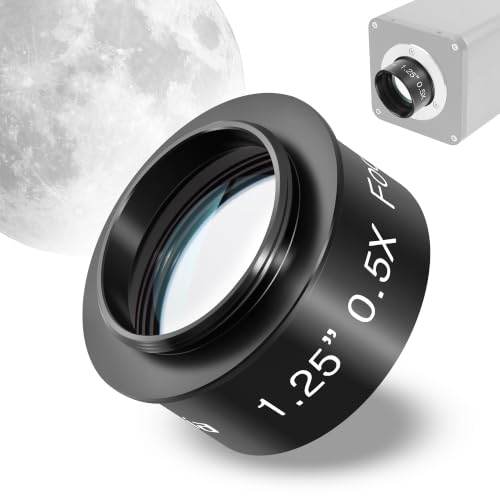 Astromania 0.5X Focal Reducer 1.25 Inch
|
9.1/10 | Buy |
| Best Budget |
 Astromania 0.5X Telescope Focal Reducer 1.25 Inch
|
8.8/10 | Buy |
 SVBONY Telescope Focal Reducer 1.25” 0.25X Focal
|
8.8/10 | Buy |
Frequently Asked Questions
What does a focal reducer actually do for a telescope?
A focal reducer shortens the effective focal length of a telescope and speeds up the focal ratio. This optical lens system widens the true field of view in your eyepiece and lowers magnification. For astrophotography, cutting the focal ratio from f/10 to f/6.3 or f/5 brightens the projected image, dramatically reducing the camera exposure time required to photograph faint nebulae and star clusters.
Can you use Best Focal Reducers For Telescopes for visual stargazing with eyepieces?
Yes, many 1.25-inch focal reducers screw directly onto standard visual eyepieces to provide lower magnification. Backyard observers frequently thread 0.5x reducer lenses into 1.25-inch ocular barrels on Maksutov-Cassegrain or refractor telescopes. However, pairing an aggressive reducer with very wide-angle eyepieces can cause optical vignetting, so moderate apparent field eyepieces yield the best edge-to-edge sharpness.
How does back focus distance affect focal reducer performance in 2026?
Precise back focus spacing directly determines the actual reduction factor and image clarity. Most reducers require a specific millimeter distance between the rear optical element and the camera sensor or eyepiece focal plane. Increasing the spacing increases the reduction factor but may introduce optical aberrations, while insufficient spacing prevents the optical system from reaching a sharp focus.
What is the difference between a focal reducer and a field flattener?
A focal reducer shrinks the focal length, whereas a field flattener corrects optical field curvature across flat camera sensors. Dedicated doublet and triplet refractor optics frequently require both functions combined in a single unit, such as an 0.8x reducer flattener. Using a reducer without flattening elements on refractor setups may leave stars near the edges of an imaging frame looking distorted or elongated.
Do focal reducers work on Newtonian reflector telescopes?
Generally no, because standard Newtonian reflectors lack sufficient inward focuser travel to reach focus with a focal reducer. Most Newtonian optical systems, including those found on equatorial reflector telescope setups, are already fast systems operating between f/4 and f/5. Reducers are primarily designed for longer focal ratio instruments like Schmidt-Cassegrains, Maksutovs, and slow refractors operating at f/8 or higher.
Can a focal reducer cause vignetting or dark corners in celestial images?
Yes, vignetting can occur if the clear optical aperture of the reducer is smaller than the light cone or camera sensor format. Using a 1.25-inch reducer with an internal clear aperture around 22mm on an APS-C or full-frame sensor will produce noticeable dark corners. Matching 2-inch reducers or specialized 41mm clear aperture Schmidt-Cassegrain units to your specific sensor size prevents light dropoff at the frame periphery.
About the author

Edward Ting writes reviews and buying guides for BSP Review.