Top Best Thermal Scopes for 300 Yards of 2026 for Night Accuracy
Spot heat signatures clearly with the best thermal scopes for 300 yards in September 2026, offering sharp sensors and dependable night tracking.
 By bsr_admin
Updated September 27, 2026
By bsr_admin
Updated September 27, 2026
Clear Night Vision Across Open Pastures
Scanning wide pastures on pitch-black nights often leaves hunters squinting at grainy heat blobs instead of identifiable targets. Hitting a varmint at three football fields away requires crisp thermal contrast, reliable base magnification, and smooth refresh rates so you do not miss sudden movement. Selecting the best thermal scopes for 300 yards means balancing 256×192 thermal sensor resolution with quality Germanium objective glass to separate coyotes from surrounding brush. Just as hunters depend on rugged glass when setting up the best scope for Savage 220 slug gun setups, night hunters need durable electronics that hold zero against repeated recoil impulses.
Thermal detection differs drastically from daytime target optics because you rely entirely on digital processing and thermal sensor sensitivity rather than ambient light gathering. Our evaluation of manufacturer specifications and user feedback reveals that optics pairing a 25mm objective lens with 50Hz refresh rate imaging produce far cleaner sight pictures on running hogs. High base magnification also protects your sight picture, since excessive digital zoom quickly degrades lower-resolution thermal sensors into pixelated squares. Whether you choose a dedicated rifle optic with recoil-activated video or a compact handheld scanner to pair with your rifle, dependable thermal gear keeps you confident when taking long-distance night shots.
| Award | Product | BSP Score About BSP ScoreThe BSP Score is our own rating from 0 to 10, based on performance, design and build, ease of use, and value. It reflects independent research and is never influenced by manufacturers, retailers, or affiliate commissions. Learn more › | |
|---|---|---|---|
| Best Overall |
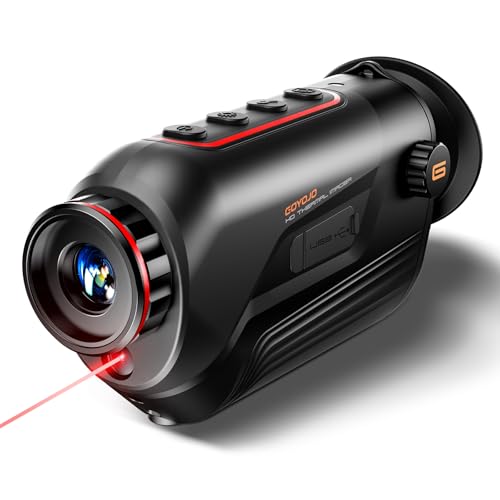 GOYOJO G215 Thermal Imaging Monocular for Hunting
|
8.8/10 | Buy |
 GOYOJO GRS225 Thermal Riflescope for Hunting
|
8.4/10 | Buy | |
 RIX Storm S2 256x192 Thermal Scope
|
8.0/10 | Buy |
Frequently Asked Questions
Can a 256×192 thermal scope clearly identify targets at 300 yards?
Yes, but positive target identification at 300 yards requires sufficient optical base magnification rather than relying on digital zoom. While entry-level 256×192 sensors can detect heat signatures well beyond 1,000 yards, digital magnification lowers the effective resolution and causes pixelation. Optic systems with a 25mm lens and higher native base magnification, like the 3.5x on the RIX Storm S2, provide the necessary detail to confirm target identity safely before pulling the trigger.
What is the difference between thermal detection range and identification range?
Detection range indicates the distance at which a thermal sensor notices an abnormal heat signature, whereas identification range is the distance needed to verify the specific animal species. Most models among the best thermal scopes for 300 yards advertise detection past 1,200 yards, meaning heat energy registers on the display. True identification at 300 yards requires analyzing body contours, movement patterns, and anatomical proportions, which demands higher optical clarity and steady 50Hz refresh rates.
Why is a 50Hz refresh rate essential for long-range night shooting?
A 50Hz refresh rate delivers smooth, real-time video without frame stutter or motion lag when panning across open ground. Lower refresh rates like 25Hz or 30Hz create noticeable display drag, making it challenging to track running coyotes or lead moving game at 300 yards. The seamless motion provided by 50Hz thermal imaging ensures your reticle stays aligned with target movement without disorienting your eyes.
How does objective lens size affect thermal optic performance?
Larger objective lenses, such as a 25mm Germanium lens, gather more thermal radiation and provide higher optical base magnification with a tighter field of view. A smaller 15mm focal lens offers a wider angle of view for close-range scanning but lacks the magnification needed for distant precision. For shooters focused on 300-yard targets, choosing a 25mm objective provides better thermal contrast and sharper target definition at distance.
Will heavy rifle recoil damage digital thermal scopes?
No, dedicated thermal riflescopes are engineered with recoil-resistant internal housing and shock-isolated electronics. Units like the GOYOJO GRS225 feature recoil ratings up to 800g, easily handling standard hunting calibers like .308 Winchester and 6.5 Creedmoor. Checking manufacturer recoil ratings and using proper mounting torque ensures your thermal sight holds zero reliably in 2026.
Can you use a handheld thermal monocular as a rifle-mounted scope?
No, handheld thermal monoculars lack aiming reticles, windage and elevation adjustments, and recoil shock resistance required for rifle mounting. Handheld devices like the GOYOJO G215 excel at wide-angle scanning and scouting heat signatures from a vehicle or stand. Pairing a handheld scanner with one of the dedicated Best Thermal Scopes For 300 Yards keeps your rifle steady until you are ready to set up an ethical shot.
About the author

bsr_admin writes reviews and buying guides for BSP Review.