
Best Budget Binoculars for Stargazing of 2026 for Night Sky Clarity
Track faint nebulae and star clusters with the best budget binoculars for stargazing updated for November 2026 to maximize light gathering on a budget.
 By Edward Ting
Updated October 10, 2026


Scanning deep-sky clusters and lunar craters demands serious light gathering, yet bulky astronomical telescopes often cost a fortune and complicate quick backyard sessions. Stargazers frequently battle shaky handheld views, dim exit pupils, and washed-out contrast when peering into the Milky Way with standard field glasses. Optical aperture makes all the difference here, as 50mm to 70mm objective lenses pull faint photons into view while high-index BaK-4 Porro prisms preserve brightness. Locating the best budget binoculars for stargazing means balancing optical magnification with a steady hold, ensuring bright edge-to-edge sharpness across wide star fields without emptying your wallet.
Based on optical specifications and user feedback, larger apertures excel at revealing stellar targets, but glass balance matters just as much as raw lens diameter. Pairing high-power optics with a stable mount from our guide to steady stargazing setups eliminates hand tremors during extended lunar viewing. Multi-coated optics and generous eye relief also prevent visual fatigue, letting you track constellations and satellites in comfort throughout cold observing nights.
| Award | Product | BSP Score About BSP ScoreThe BSP Score is our own rating from 0 to 10, based on performance, design and build, ease of use, and value. It reflects independent research and is never influenced by manufacturers, retailers, or affiliate commissions. Learn more › | |
|---|---|---|---|
| Best Overall |
20x50 High Powered Binoculars for Adults
|
8.6/10 | Buy |
| Best Value |
 Adasion 15x56 Binoculars for Adults High Powered |
8.6/10 | Buy |
 Aurosports 12x32 Compact Binoculars for Adults |
8.1/10 | Buy | |
| Best Premium |
 20x50 Binoculars for Adults High Powered |
8.0/10 | Buy |
 Celestron SkyMaster 15x70 Astronomy Binoculars |
8.0/10 | Buy | |
| Best Budget |
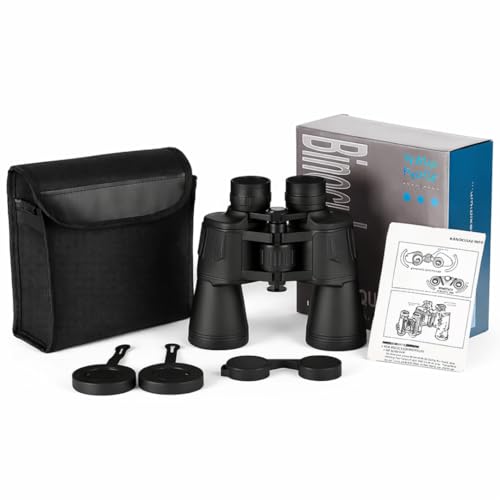 ZORIVA 10x50 Professional High-Power Binoculars |
7.8/10 | Buy |
Frequently Asked Questions
What magnification is best for budget astronomy binoculars?
A magnification between 10x and 15x offers the sweet spot for night sky scanning. Powers in this range pull in deep lunar craters and open star clusters like the Pleiades without creating extreme image jitter. Magnifications above 12x reveal incredible detail, though most skywatchers will prefer mounting them to keep the view rock steady.
Why do stargazers prefer Porro prisms over Roof prisms in affordable optics?
Traditional Porro prism architecture provides superior light transmission and greater depth perception at entry-level price points. Roof prisms require phase-correction coatings and dielectric mirror treatments to avoid light loss, which drives up retail costs. Budget Porro sets deliver brighter contrast and richer star clusters because internal light reflects without complex mirror layers.
Do you need a tripod adapter for high-power stargazing binoculars?
Yes, mounting binoculars with 15x magnification or larger objective lenses is essential for eliminating image shake. Holding heavy 50mm or 70mm barrels steady by hand tires your arms quickly and smears pinpoint stars into blurry streaks. Attaching a standard binocular tripod adapter locks your view onto faint nebulae and keeps the image perfectly stationary.
How does objective lens size affect night sky viewing?
Larger objective lenses collect exponentially more light to reveal dim deep-sky targets. A 50mm or 70mm front lens pulls in far more photons than smaller daytime optics, producing a bright exit pupil in complete darkness. While 50mm objectives found on classic marine binoculars deliver wide views, 70mm astronomical glass reaches deeper into light-polluted suburban skies.
Can eyeglass wearers comfortably use budget stargazing binoculars?
Yes, as long as the binoculars provide at least 15mm to 20mm of eye relief. Folding or twist-up rubber eyecups allow spectacle lenses to sit at the correct optical distance without scratching coatings. Generous eye relief eliminates peripheral blackouts, ensuring you see the full celestial field of view with your glasses on.
What is the difference between BaK-4 and BK-7 glass for stargazing?
BaK-4 barium crown glass offers higher optical density and produces a clean, perfectly circular exit pupil. Cheaper BK-7 borosilicate glass often squares off the edges of the exit pupil, causing light falloff around the periphery. Opting for BaK-4 glass preserves maximum light throughput and keeps stars sharp across the entire field.
About the author
Edward Ting is an experienced amateur astronomer, telescope reviewer, and astronomy educator known for his detailed equipment evaluations. With an engineering background and extensive experience reviewing telescopes and astronomical accessories, he helps astronomy enthusiasts understand optical performance, equipment design, and practical considerations when selecting observing equipment.