Best Budget Kids Telescopes of 2026 for Young Stargazers
Best budget kids telescopes for September 2026 offer steady tripod mounts, clear lunar views, and simple refractor setups for young backyard astronomers.
 By bsr_admin
Updated September 27, 2026
By bsr_admin
Updated September 27, 2026
Clear Lunar Views on a Starter Stargazing Budget
Nothing dampens a young observer’s excitement faster than a wobbly tripod that shakes the Moon completely out of sight during focusing. Many starter kits look impressive in promotional pictures, but lightweight plastic mounts and low-grade lenses often yield frustrating, blurry views rather than crisp lunar details. Selecting the best budget kids telescopes requires prioritizing solid mechanical stability and clear optical glass over exaggerated magnification marketing. Modest refractor setups with 50mm to 70mm objective lenses collect ample light for bright targets while remaining remarkably simple for young hands to operate.
Portability plays an equally critical role when children want to observe from a backyard lawn, a campsite, or an apartment balcony. Smooth alt-azimuth adjustments allow intuitive pointing across the night sky without requiring complicated alignment routines or heavy balance weights. Stargazing families should always note that viewing the Sun without a certified, front-aperture solar filter causes permanent eye damage. Pairing manageable optics with realistic expectations ensures these beginner telescopes encourage lasting curiosity instead of quick boredom.
| Award | Product | BSP Score About BSP ScoreThe BSP Score is our own rating from 0 to 10, based on performance, design and build, ease of use, and value. It reflects independent research and is never influenced by manufacturers, retailers, or affiliate commissions. Learn more › | |
|---|---|---|---|
| Best Overall |
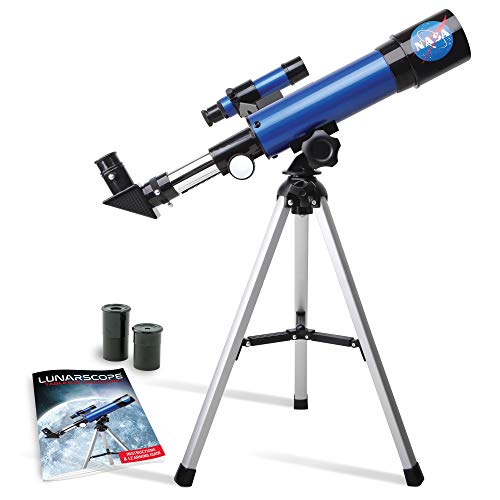 NASA Lunar Telescope for Kids Ages 8-12
|
8.8/10 | Buy |
| Best Premium |
 Gskyer Telescope, 70mm Aperture 400mm AZ Mount
|
8.4/10 | Buy |
| Best Budget |
 Telescope for Kids, 50mm 100x Beginner Telescope
|
8.1/10 | Buy |
 Telescope for Adults & Kids
|
8.1/10 | Buy | |
 Telescope for Kids, 50mm 100x Silver Beginner
|
7.8/10 | Buy |
Frequently Asked Questions
Which optical design works best for a child’s first telescope?
A compact refractor telescope is generally best for young beginners. Sealed refractor tubes protect delicate glass lenses from dust and require zero optical collimation, unlike open Newtonian reflector telescopes. Their straight-through viewing angle also makes aiming intuitive when paired with a basic alt-azimuth mount.
What is a realistic magnification limit for budget kids telescopes?
A practical limit ranges between 50x and 100x magnification for 50mm to 70mm objective lenses. Although packaging often boasts 150x or more, pushing small apertures beyond realistic thresholds dims the image and magnifies vibrations. Lower-power eyepieces like 20mm deliver much sharper planetary contrast and wider views.
What celestial objects can children see with the best budget kids telescopes in 2026?
Young observers can clearly explore lunar craters, the crescent phase of Venus, Jupiter alongside its four Galilean moons, and the oval outline of Saturn’s rings. Bright star clusters like the Pleiades also resolve nicely through coated optics. Distant nebulae and galaxies, however, will appear only as faint gray smudges.
Can these beginner telescopes work effectively in light-polluted suburban areas?
Yes, starter refractors perform well on bright targets like the Moon and major planets even under suburban light pollution. High-contrast solar system targets cut through neighborhood skyglow easily without needing dark rural skies. Fainter star fields will show improved contrast if you bring the portable scope to a darker park.
Can children look at the Sun through these starter telescopes?
No, children must never aim a telescope toward the Sun without a certified, front-aperture solar filter fitted securely over the lens. Focusing direct solar rays into the eye causes instantaneous, irreversible blindness. For daytime exploration, these refractor telescopes should only be used to view distant landscapes, birds, or boats.
About the author

bsr_admin writes reviews and buying guides for BSP Review.