
Best Monocular Spotting Scope of 2026 for Field Clarity
Selecting the Best Monocular Spotting Scope enhances target resolution, field packability, and low-light shooting accuracy as of November 2026.
 By Phil Harrington
Updated November 6, 2026


Struggling with a dim sight picture or heavy pack weight can quickly ruin an early morning glassing session on the ridge. Heavy full-sized optics often stay in the truck because they take up too much pack space, while cheap glass fails right when legal shooting light arrives. Finding the best monocular spotting scope requires balancing lightweight field portability with high optical light transmission. Modern shooters need dependable weatherproofing, clear prism assemblies, and reliable resolution to identify bullet impacts on distant paper or spot game bedding in timber. You can pair these observation tools alongside a dedicated setup using our guide to the Best Monocular Spotting Scope of 2026 for Long-Range Precision to cover every yardage requirement.
Careful evaluation of technical specifications shows that fully multi-coated optics and BAK4 roof or Porro prism glass make a massive difference in color fidelity and edge contrast. Nitrogen or argon gas purging prevents sudden internal fogging during cold, rainy mornings, ensuring your sightline stays crystal clear. Reliable eyepiece construction also gives you generous eye relief, saving you from constant eye fatigue during extended glassing sessions. If you also run bench setups, pairing field spotters with the Best Monocular Spotting Scope of 2026: Precision Bench Picks ensures seamless target spotting from the firing line to downrange steel.
| Award | Product | BSP Score About BSP ScoreThe BSP Score is our own rating from 0 to 10, based on performance, design and build, ease of use, and value. It reflects independent research and is never influenced by manufacturers, retailers, or affiliate commissions. Learn more › | |
|---|---|---|---|
| Best Overall |
tridaptor - Universal Digiscoping Adapter
|
9.1/10 | Buy |
| Best Value |
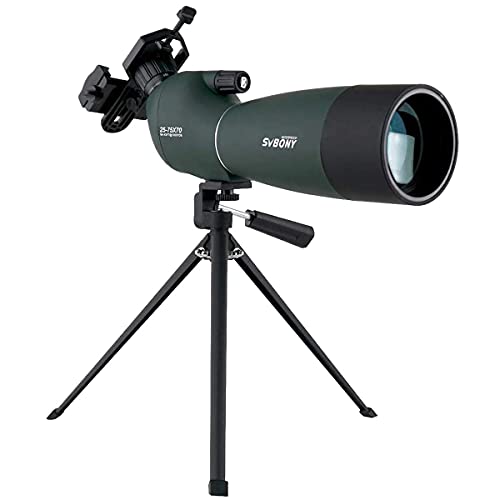 SVBONY SV28 Spotting Scope |
9.1/10 | Buy |
| Best Premium |
 Flagship 20-60x80 Spotting Scope with Tripod |
8.9/10 | Buy |
 Vortex Viper HD Spotting Scope (15-45x65 Angled) |
8.9/10 | Buy | |
 tridaptor - Universal Phone Scope Digiscoping |
8.4/10 | Buy | |
| Best Budget |
 Monocular Telescope High Power 8x42 Monoculars |
8.3/10 | Buy |
Frequently Asked Questions
What objective lens diameter works best for low-light target identification?
An objective lens between 60mm and 80mm delivers the best balance of low-light performance and packable weight. Larger objective lenses let in significantly more ambient light during dawn and dusk, which maintains target contrast at higher magnifications. However, large 80mm bells add extra weight and bulk to your field pack, while compact 42mm lenses excel at handheld scouting during midday. Shooters interested in maximizing dawn brightness on standard firearms can compare glass dimensions against our review of the Best Monocular Spotting Scope of 2026 for Low Light Clarity.
Do I need a tripod to use a high-magnification monocular spotting scope?
Yes, any optical magnification over 10x or 12x requires a solid tripod to eliminate image-blurring hand tremor. At powers like 20x to 60x, natural muscle twitches make it almost impossible to maintain a steady sight picture or spot bullet holes on distant paper. Compact tabletop tripods provide rigid bench stability at target ranges, while full-height carbon tripods suit standing glassing on mountain ridges. Lightweight handheld monoculars around 8x power remain the best choice for fast, unsupported scouting.
What is the difference between straight and angled eyepiece spotting scopes?
Angled eyepieces allow comfortable viewing from multiple heights without requiring major tripod leg adjustments. This 45-degree configuration works exceptionally well for benchrest shooters, prone target spotters, and groups of varied heights sharing a single optic. Straight spotting scopes make initial target acquisition faster because you simply look straight along the barrel at the target. Straight bodies also slide in and out of pack side pockets much easier when moving quickly through dense brush.
How does a 3-axis digiscoping phone adapter improve long-range viewing?
A rigid 3-axis metal adapter aligns your smartphone camera directly with the exit pupil to eliminate black edge vignetting. It lets you view targets comfortably on a large digital screen rather than straining your eye against a rubber eyecup for hours. Adjusting the Z-axis dial sets the exact eye relief distance required to deliver a crisp, round frame. Using an included remote shutter switch prevents phone shaking so your recorded video and still photos stay razor sharp.
Why is argon purging preferred over nitrogen for optical fogproofing?
Argon gas features larger internal molecules that resist leaking past rubber O-rings over extended years of temperature cycling. Both inert gases effectively prevent moisture from causing internal glass fogging when transitioning between warm trucks and freezing mountain air. Argon does not react chemically with internal optical components or seals, maintaining pristine glass clarity over long service lives. Nitrogen remains effective and economical, making it a standard choice across entry and mid-tier spotting scopes.
About the author
Phil Harrington is an astronomy educator, author, and experienced optical equipment reviewer with decades of experience exploring the night sky. He has written extensively about telescopes, binoculars, and astronomical observation, combining technical knowledge with practical guidance that helps astronomy enthusiasts understand and select suitable observing equipment.