
What Is an Acog Scope: A Practical Guide to Prism Optics for 2026
Learn what is an acog scope, how fixed-power prism optics work, and why shooters choose etched reticles in November 2026.
 By John Snow
Updated November 13, 2026


Carbine marksmanship often demands a balance between split-second target acquisition and intermediate-range precision. When shooters ask what is an acog scope, they are exploring one of the most durable combat optics ever fielded on modern rifles. The acronym stands for Advanced Combat Optical Gunsight, a category originally engineered by Trijicon to deliver fixed magnification, rugged housing integrity, and reliable reticle illumination without delicate moving parts. Unlike conventional variable-power rifle scopes that rely on internal erector tubes and mechanical zoom assemblies, an ACOG utilizes a compact prism optical system. This configuration shortens the overall optic footprint while retaining high light-gathering efficiency and crisp edge-to-edge optical resolution.
Understanding the mechanical operation of these sights helps shooters determine whether a fixed-power prism optic aligns with their specific carbine setup. Many marksmen seeking alternatives to red dots find that prism designs resolve common visual distortions, especially when pairing primary glass with micro red dots for astigmatism on tactical rifles. Traditional red dot sights project reflected LED light off a front lens element, which can bloom or starburst for shooters with imperfect vision. In contrast, an ACOG features an etched glass reticle that remains permanently visible and razor-sharp regardless of battery power or illumination status. By examining optical construction, reticle architecture, mounting footprints, and field applications, marksmen can make informed decisions when outfitting their defensive, patrol, or recreational carbines.
| Award | Product | BSP Score About BSP ScoreThe BSP Score is our own rating from 0 to 10, based on performance, design and build, ease of use, and value. It reflects independent research and is never influenced by manufacturers, retailers, or affiliate commissions. Learn more › | |
|---|---|---|---|
| Best Overall |
Ozark Armament 4x32 Rifle Scope with Picatinny
|
8.6/10 | Buy |
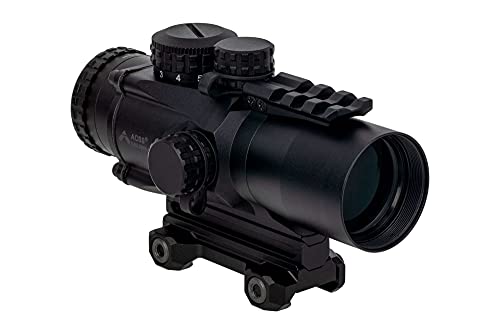 Primary Arms SLX 3x32mm Gen III Prism Scope |
8.3/10 | Buy | |
 Trijicon 4x32 ACOG TA01NSN308 Scope with Amber |
8.0/10 | Buy |
Understanding the Engineering and Field Role of ACOG Scopes
The Advanced Combat Optical Gunsight represents a specialized branch of optical design known as the prism scope. Rather than routing incoming light through a series of spherical lenses inside a long aluminum body tube, an ACOG folds the optical path through a glass prism assembly. This folded design yields a significantly shorter overall optic housing while preserving the focal length required for crisp magnification. The fixed magnification profile, typically standard at 4x magnification with a 32mm objective lens, eliminates the complex mechanical linkages found in low power variable optics. Fewer moving parts translate directly into exceptional structural rigidity, making the optic capable of enduring heavy recoil impulse, rough transport, and severe environmental shifts.
Optical Mechanics and the Prism Sight System
Traditional telescopic sights use multiple lens elements aligned along an internal erector tube that shifts axially when changing magnification or dialing turrets. In contrast, prism optics invert and magnify the image using internal reflection inside a single solid glass prism block. This arrangement shortens the required physical housing length by several inches compared to traditional variable rifle scopes. The reduced physical footprint benefits carbine balance by keeping the firearm mass concentrated directly above the receiver rather than extending forward over the handguard.
Prism systems also deliver a distinct optical advantage through physical reticle etching. In a standard reflex sight, an electronic LED projects light toward a reflective coating, creating a floating aiming point that vanishes if electrical power fails. In an ACOG scope, the reticle pattern is mechanically etched directly into the optical glass surface. Even if all ambient or internal illumination sources are completely depleted, the black etched reticle remains crisp and functional against daylight targets. This physical etching ensures continuous aiming capability across varied field conditions without complete dependence on electronic circuitry.
Exit pupil diameter plays a vital role in optical brightness and target engagement speed. Calculated by dividing the objective lens diameter by the magnification power, an optic featuring a 32mm objective with 4x magnification yields an 8mm exit pupil. This generous beam of light matches or exceeds the dilation capacity of the human eye in daylight and twilight settings. As a result, the shooter enjoys a bright, high-contrast sight picture that supports rapid target identification during critical low-light transitions at dawn or dusk.
Reticle Illumination Technologies and the Bindon Aiming Concept
Illumination management is one of the most distinctive features of premium ACOG systems like the Trijicon 4×32 ACOG TA01NSN308 Scope with Amber. Many authentic combat models incorporate dual or single battery-free illumination sources. During daytime operations, ambient light can be collected through external fiber-optic light pipes running along the top of the housing to illuminate the reticle center. In complete darkness, self-luminous radioactive tritium gas lamps generate a continuous glow that provides contrast against shadowed targets without external batteries.
In addition to battery-free tritium and fiber optics, modern prism sights have embraced electronic battery systems to offer adjustable intensity control. Sights such as the Primary Arms SLX 3x32mm Gen III Prism Scope utilize standard coin-cell batteries to deliver daylight-bright red illumination across 11 brightness settings. Similarly, the Ozark Armament 4×32 Rifle Scope with Picatinny features a tricolor red, green, and blue illuminated reticle to help users match reticle contrast to background foliage and lighting conditions. Etched glass construction ensures that whether powered by tritium, ambient light pipes, or internal batteries, reticle functionality never drops to zero if the power source is exhausted.
The Bindon Aiming Concept, pioneered by Trijicon founder Glyn Bindon, allows shooters to engage targets rapidly at close range while utilizing a magnified optic. When tracking targets with both eyes open, the brain superimposes the bright illuminated reticle from the dominant eye over the unmagnified field of view seen by the support eye. As the carbine stops moving and settles onto the target, the brain instantly shifts visual focus to the magnified sight picture for precise shot placement. This optical phenomenon bridges the gap between close-quarters reflex speed and intermediate-range target engagement without requiring manual zoom adjustments.
Ballistic Drop Compensation and Target Ranging Reticles
Modern carbine engagements rarely allow time for dial-in elevation adjustments on exposed mechanical turrets. Because of this reality, ACOG reticles integrate dedicated Ballistic Drop Compensating (BDC) crosshair grids calibrated for specific centerfire rifle cartridges. For example, reticle variants are calibrated to match the flight paths of standard military loadings such as 5.56 NATO or 7.62 NATO/.308 Winchester out to 600 or 800 meters. Hash marks below the primary aiming chevron or crosshair indicate holdover points corresponding to specific target distances.
Advanced reticle designs expand this capability by combining holdovers with passive target ranging brackets. The ACSS 5.56 CQB-M2 reticle found on the Primary Arms SLX 3x32mm Gen III Prism Scope incorporates ranging lines calibrated against standard human silhouette dimensions. Shooters can range targets out to extended distances simply by fitting the target outline between horizontal stadia lines. Furthermore, wind hold dots and moving target leads calibrated for steady crosswinds provide immediate aiming references without manual turret dialing.
Using BDC reticles successfully requires understanding ammunition velocity variances. Reticles calibrated for a specific military load, such as 62-grain M855 or 147-grain M80 ball, assume a predetermined muzzle velocity and atmospheric condition. If a shooter fires a significantly lighter or heavier projectile, or fires from a shorter carbine barrel, the downrange bullet drop will diverge slightly from the etched stadia lines. Verifying practical impacts on paper targets at 200, 300, and 400 yards allows marksmen to map exact point-of-impact differences for their specific barrel length and ammunition profile.
Eye Relief, Eyebox Characteristics, and Mounting Considerations
One operational compromise inherent to compact 4x prism designs is a relatively short eye relief distance. A standard 4×32 ACOG requires the shooter to position their eye approximately 1.5 inches from the ocular lens to achieve a full, unvignetted sight picture. This tight optical distance necessitates mounting the optic rearward along the receiver rail to establish a consistent cheek weld. Shooters running heavier calibers or non-collapsible stocks must remain aware of this physical eye spacing to prevent uncomfortable recoil contact with the ocular housing.
To mitigate tight eye relief constraints, contemporary prism manufacturers have engineered models with lower magnification profiles. The Primary Arms SLX 3x32mm Gen III Prism Scope operates at 3x magnification, which expands eye relief and yields a more forgiving eyebox latitude. A more forgiving eyebox allows shooters to acquire a usable sight picture from awkward field shooting positions, including barricade support, prone rollover, and kneeling angles. The trade-off between higher magnification reach and eye relief comfort remains an essential factor when selecting fixed optics.
Proper mounting hardware ensures that mechanical zero is preserved through rigorous range sessions. Standard prism optics attach directly to Picatinny (MIL-STD-1913) rails using integrated crossbolts, recoil lugs, or proprietary carry handle mounting channels. While conventional scopes require separate rings, matching mounting footprints and hardware described in our scope mounting hardware guide shows how solid mechanical interfaces eliminate flex. Tightening mounting screws with a calibrated inch-pound torque tool prevents stripping aluminum threads while guaranteeing zero retention under heavy centerfire recoil.
Durability Standards, Environmental Sealing, and Construction
Combat optical sights earned their military reputation primarily through survivability under extreme operational conditions. Premium ACOG bodies are forged from high-strength 7075-T6 aircraft aluminum alloy, creating an exceptionally tough unibody shell around the internal prism. The absence of external moving zoom rings or delicate erector springs eliminates primary points of water intrusion and structural failure. The resulting housing is engineered to withstand immersion, high impact drops, and harsh concussive shockwaves from muzzle blast.
Environmental sealing prevents internal optical fogging caused by sudden ambient temperature drops. Quality prism optics undergo complete internal dry nitrogen purging and O-ring sealing around turret caps, ocular housings, and objective lenses. Nitrogen purging displaces moisture-laden oxygen molecules, ensuring that interior glass elements do not develop condensation when moving from a heated vehicle into freezing rain. External lenses receive specialized multi-coatings that maximize light transmission and protect the glass from fine dust abrasion during extended field carry.
Mechanical turret design on prism scopes focuses on protection rather than exposed tactical dialing. Adjustment turrets typically feature rugged metal threaded caps with rubber O-ring seals to lock out water and mud. Underneath the protective caps, low-profile tool-adjustable or finger-adjustable screws offer distinct 1/4 MOA or 1/2 MOA click increments. Because shooters rely on the etched BDC reticle for elevation and windage corrections, turrets are intended to remain capped once initial zeroing at 100 yards is established.
Comparing ACOG Prism Scopes with Low Power Variable Optics (LPVO)
Modern carbine shooters frequently weigh the benefits of fixed-power prism scopes against Low Power Variable Optics (LPVOs) offering 1-6x or 1-8x zoom ranges. LPVOs provide exceptional versatility by allowing marksmen to switch between true 1x unmagnified speed and high-magnification precision for positive target identification. However, this mechanical versatility comes with substantial penalties in overall rifle weight and physical bulk. A typical variable optic paired with a cantilever mount can easily add 25 to 30 ounces to the upper receiver.
In contrast, fixed prism scopes provide a streamlined, lightweight footprint that preserves the rapid handling characteristics of defensive carbines. While an LPVO demands constant adjustment of throw levers, diopters, and illumination dials, an ACOG offers continuous readiness with zero user intervention. Shooters operating in thick brush or harsh alpine conditions often prefer this mechanical simplicity. Marksmen looking to balance magnification power with light-gathering efficiency can study our low-light rifle optics guide to explore how objective lens architecture impacts target separation in dim environments.
Secondary sighting solutions also help bridge the close-quarters gap for fixed 4x optics. Many prism sights, including the Primary Arms SLX Gen III and select Trijicon models, incorporate mounting screw patterns or top-mounted Picatinny rails. These mounting provisions allow users to piggyback a miniature reflex sight directly above the objective housing. By tilting the rifle slightly or shifting head position, shooters can transition instantly between a 1x reflex dot for point-blank threats and 4x magnified glass for distant silhouettes.
Zeroing and Maintenance Best Practices for Prism Optics
Establishing an accurate zero is essential for maximizing the utility of ballistic drop compensating reticles. Before zeroing, always ensure the firearm is completely unloaded and pointed in a safe direction while verifying mounting screw tightness with calibrated torque tools. Most 5.56 and .308 BDC reticles are engineered around a standard 100-meter or 100-yard zero baseline. Dialing the primary tip of the chevron or center crosshair to match bullet impacts at 100 yards establishes the baseline geometry needed for subsequent drop lines to align properly downrange.
Maintaining anti-reflective lens coatings requires careful handling to prevent fine scratches that scatter incoming light. Never wipe dry lenses with field jackets, cotton shirts, or paper towels, as embedded silica particles can act like fine sandpaper against delicate multi-coated glass. Always clear coarse dust using a soft optical brush or bulb air blower before applying dedicated lens cleaning fluids and microfiber cloths. Keeping protective lens covers closed during transit protects the objective glass from gravel, chemical solvents, and direct sunlight degradation.
Choosing an ACOG or prism optic provides a dependable balance of durability, optical clarity, and swift target engagement. Whether selecting a combat-proven model with tritium illumination or a versatile battery-illuminated alternative with an advanced ACSS reticle, understanding prism mechanics ensures that shooters select the right tool for their practical shooting demands.
About the author
John Snow is an established outdoor journalist and equipment editor with decades of experience covering technical innovations, product evaluations, and outdoor equipment. His background in investigative reporting and technical journalism provides a strong foundation for explaining complex product specifications and helping consumers understand equipment performance.