Reflector vs Refractor Telescope of 2026 Guide for Stargazers
Aperture size and optical clarity settle the reflector vs refractor telescope debate this September 2026 for backyard astronomers.
 By bsr_admin
Updated September 28, 2026
By bsr_admin
Updated September 28, 2026
Unwanted purple halos around the Moon often frustrate newcomers using budget glass lenses. Refractor designs use curved lenses that bend light wavelengths unevenly, while reflecting models reflect light to a focal point without false color. Evaluating a reflector vs refractor telescope comes down to balancing light-gathering power against optical maintenance. Beginner observers appreciate the sealed tube of a refractor, yet Newtonian reflectors deliver a larger clear optical aperture for viewing faint nebulae. Upgrading to quality telescope eyepieces helps either optical setup extract sharp planetary detail across varied sky conditions.
Mount stability and mechanical alignment also dictate your stargazing satisfaction. The Gskyer 130EQ Professional Astronomical Reflector pairs an advanced German equatorial mount with a 5.1-inch aperture to pull in dim star clusters. Telescopes on equatorial heads require balancing and polar alignment, but they make manual tracking across the night sky remarkably smooth. Pointing any optical tube at the Sun without a certified front-aperture solar filter causes permanent eye damage. Aligning your setup with accurate telescope finder scopes keeps celestial targets centered throughout the evening.
| Award | Product | BSP Score About BSP ScoreThe BSP Score is our own rating from 0 to 10, based on performance, design and build, ease of use, and value. It reflects independent research and is never influenced by manufacturers, retailers, or affiliate commissions. Learn more › | |
|---|---|---|---|
| Best Overall |
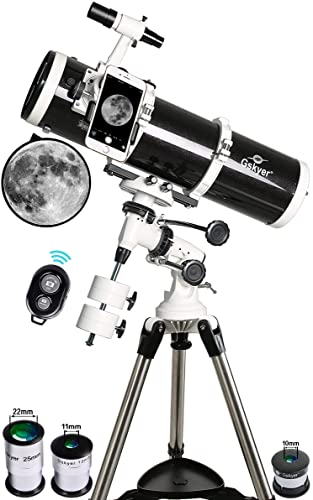 Gskyer 130EQ Professional Astronomical Reflector
|
8.6/10 | Buy |
Frequently Asked Questions
What is the primary difference in a reflector vs refractor telescope?
Lens optics versus mirror optics represent the foundational difference. Refractor telescopes collect light using front glass objective lenses, creating crisp planetary contrast inside a sealed tube assembly. Reflector telescopes collect light using curved mirrors at the rear of an open tube, yielding greater aperture diameter at lower cost. Stargazers targeting faint nebulae choose reflectors, while observers seeking zero maintenance prefer refractors.
Do reflector telescopes require frequent optical collimation?
Yes, reflector telescopes occasionally require mirror alignment to maintain sharp optical resolution. Mechanical vibration during storage or transit can shift mirror alignment slightly out of place. Realigning the primary and secondary optics takes only a few minutes with a simple collimation cap. Refractors feature factory-fixed glass elements, making them convenient grab-and-go options for young stargazers.
Can you see deep-sky objects better with a reflector or a refractor?
Reflectors generally perform better on deep-sky objects due to their larger aperture per dollar. Light gathering scales directly with the surface area of the primary optical element, allowing a 130mm mirror to gather substantially more light than a standard 70mm refractor. This extra light reveals subtle details in distant star clusters and galaxies under dark suburban skies.
Why do refractors suffer from chromatic aberration while reflectors do not?
Standard achromatic refractors bend color wavelengths at slightly different angles, producing purple fringing around bright celestial bodies. Newtonian reflectors bounce incoming light off reflective mirrors without passing through thick glass elements, avoiding chromatic aberration completely. Observers seeking pure lunar and planetary contrast value this optical purity in a mirror system like the Gskyer 130EQ Professional Astronomical Reflector.
What mount type is best when comparing a reflector vs refractor telescope for beginners?
Alt-azimuth mounts suit absolute beginners best, while equatorial mounts reward patient observers. Alt-azimuth setups move up-down and left-right for rapid target acquisition. German equatorial mounts align with the Earth’s axis, letting you track moving celestial objects across 2026 night skies using a single slow-motion cable.
About the author

bsr_admin writes reviews and buying guides for BSP Review.