
Best Refractor Telescopes for Viewing Planets and Galaxies of 2026 for Sharp Views
Best refractor telescopes for viewing planets and galaxies offer crisp lunar views. Review top optical gear and stable mounts for November 2026.
 By Phil Harrington
Updated September 28, 2026


Purple color fringing around lunar craters and shaky tripod legs often spoil what should be an exciting evening under the night sky. Many stargazers struggle with lightweight mounts that shudder at the slightest touch, turning Saturn into a vibrating smear. Achieving high-contrast planetary detail demands well-figured glass lenses matched with steady alt-azimuth or equatorial supports. Investing in the best refractor telescopes for viewing planets and galaxies bypasses optical alignment headaches while providing pinpoint star fields. If you are comparing different optical styles alongside an equatorial reflector telescope setup, glass refractors stand out for rapid backyard deployment and zero routine maintenance.
Adequate aperture diameter and quality optical coatings govern how much celestial detail reaches your eye. An 80mm or 90mm objective lens pulls in sufficient light to reveal Jupiter’s major cloud belts, bright globular clusters, and bright deep-sky targets like the Andromeda Galaxy. Based on optical specifications and user feedback, fully multi-coated elements suppress internal reflections and maximize contrast across dark skies. Note that solar viewing requires extreme caution: never point any telescope at the sun without a certified front-aperture solar filter securely attached, as direct solar rays cause instant, irreversible blindness.
| Award | Product | BSP Score About BSP ScoreThe BSP Score is our own rating from 0 to 10, based on performance, design and build, ease of use, and value. It reflects independent research and is never influenced by manufacturers, retailers, or affiliate commissions. Learn more › | |
|---|---|---|---|
| Best Overall |
90mm Telescope for Adults High Powered
|
9.2/10 | Buy |
| Best Premium |
 Celestron StarSense Explorer LT 80AZ Smartphone |
9.2/10 | Buy |
| Best Value |
 MEEZAA Telescope, Telescope for Adults |
9.1/10 | Buy |
| Best Budget |
 Koolpte Telescope for Adults & Beginner |
8.6/10 | Buy |
 Gskyer Telescope, 70mm Aperture 400mm AZ Mount |
8.4/10 | Buy | |
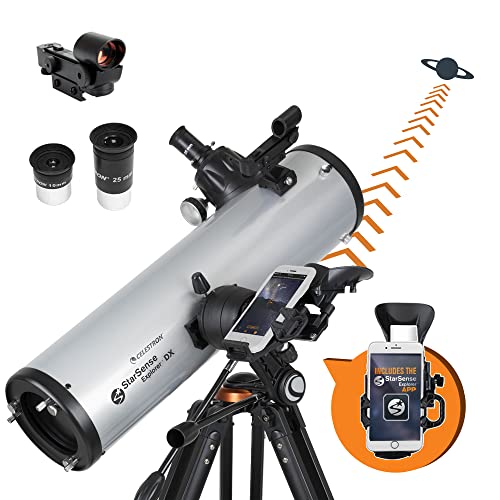 Celestron StarSense Explorer DX 130AZ Smartphone |
8.3/10 | Buy | |
 Telescope for Adults & Kids |
8.1/10 | Buy |
Frequently Asked Questions
Can you see deep-sky galaxies with refractor telescopes?
Yes, an 80mm to 90mm refractor can reveal bright deep-sky galaxies like the Andromeda Galaxy (M31) from dark observation sites. While refractor lenses excel at lunar contrast, resolving distant galaxies depends heavily on dark skies rather than extreme magnification. Under light-polluted suburban skies, galaxies appear as soft grey smudges rather than detailed spirals. Selecting the best refractor telescopes for viewing planets and galaxies in 2026 ensures high optical transmission for these faint targets.
What causes purple fringing around bright planets in entry-level refractors?
Chromatic aberration causes purple halos around bright objects due to differing wavelengths of light focusing at varied focal points. Achromatic doublet lenses focus red and blue light slightly apart, creating visible color fringing on high-contrast targets like Venus or the lunar limb. Telescopes with longer focal ratios, such as f/8 or higher, naturally suppress this effect. Using moderate magnification eyepieces also keeps planetary discs crisp and reduces distracting false color.
How much magnification do you realistically need for viewing Saturn and Jupiter?
Useful planetary observation requires between 50x and 150x magnification. Unrealistic claims of 300x or 500x power on small telescopes produce dark, blurry images ruined by atmospheric seeing conditions. An 80mm refractor comfortably reveals Saturn’s ring system and Jupiter’s four Galilean moons within normal power limits. For families seeking simpler starter equipment, budget-friendly stargazing scopes offer clear planetary views without overwhelming technical controls.
Do refractor telescopes require regular optical collimation?
No, refractor telescopes feature factory-aligned glass objectives sealed securely in their tubes that never require user collimation. Unlike Newtonian reflectors that demand frequent mirror adjustments, refractors withstand bumpy car rides to dark sky parks without losing optical alignment. Their sealed optical tubes also keep dust and moisture away from interior surfaces, making them dependable grab-and-go observation tools.
Why is mount stability more critical than high magnification?
A sturdy telescope mount prevents annoying vibrations that make celestial objects dance out of your field of view. High magnification amplifies every slight tremor from wind or focusing adjustments, quickly ruining delicate planetary observations. Smooth manual slow-motion altitude controls allow seamless tracking as targets drift across the sky. Pairing stable optical tubes with practical astronomy observation books and star charts ensures an enjoyable, productive night under the stars.
About the author
Phil Harrington is an astronomy educator, author, and experienced optical equipment reviewer with decades of experience exploring the night sky. He has written extensively about telescopes, binoculars, and astronomical observation, combining technical knowledge with practical guidance that helps astronomy enthusiasts understand and select suitable observing equipment.