Best Photography Telescopes of 2026 for Deep Sky Imaging
Capture faint nebulae with best photography telescopes in September 2026, featuring automated star tracking and crisp digital sensors.
 By bsr_admin
Updated September 28, 2026
By bsr_admin
Updated September 28, 2026
Clear Night Sky Views Without Astrophotography Headaches
Struggling with polar alignment in the freezing dark often turns an exciting night of stargazing into pure frustration. Bulky equatorial mounts and tedious cable connections make spontaneous observation sessions feel like hard labor before you even focus a lens. Selecting the best photography telescopes allows you to bypass these traditional hurdles thanks to integrated camera sensors and automated target tracking. Modern smart optical setups bring faint galaxies and glowing nebulae straight to your smartphone screen within minutes. Backyard observers who want simpler imaging workflows can compare these digital units against traditional gear like an equatorial reflector telescope to see how much setup time automated alignment truly saves.
Careful analysis of current optical tube assembly specs shows that compact digital scopes now offer serious light-gathering power without backbreaking weight. Dedicated astronomy sensors alongside apochromatic optical glass help minimize chromatic aberration while capturing vivid deep-sky details. Built-in light pollution filters also cut through severe suburban glow, making high-contrast imaging realistic right from an urban patio. Whether you want wide starscapes or detailed snapshots of the Moon, investing in the right best photography telescopes turns fleeting clear nights into rewarding celestial captures.
| Award | Product | BSP Score About BSP ScoreThe BSP Score is our own rating from 0 to 10, based on performance, design and build, ease of use, and value. It reflects independent research and is never influenced by manufacturers, retailers, or affiliate commissions. Learn more › | |
|---|---|---|---|
| Best Overall |
 DWARFLAB Dwarf Mini Smart Telescope
|
9.1/10 | Buy |
| Best Value |
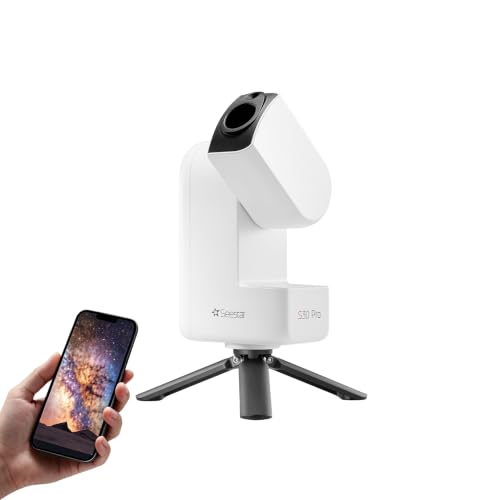 ZWO Seestar S30 Pro Smart Telescope
|
8.3/10 | Buy |
Frequently Asked Questions
Can smart photography telescopes capture deep-sky objects under suburban light pollution?
Yes, smart telescopes with integrated light pollution filters can reliably reveal nebulae and star clusters from bright city backyards. The automated live-stacking software combines dozens of short exposures to isolate faint celestial signals from background skyglow. Both the DWARFLAB Dwarf Mini Smart Telescope and ZWO Seestar S30 Pro Smart Telescope feature specialized filtration to handle high Bortle scale environments.
Do modern digital photography telescopes require optical collimation?
No, all-in-one smart telescopes feature factory-sealed optical assemblies that never require routine mirror alignment. Unlike Newtonian reflectors that need frequent collimation adjustments to maintain sharpness, these refractors stay aligned through transport. This makes grab-and-go astrophotography much faster for spontaneous night sky sessions.
Can the 2026 best photography telescopes view planets like Jupiter and Saturn?
No, compact smart telescopes are engineered specifically for wide-field deep-sky objects and the Moon rather than planetary disc detail. Small sensor formats and wide focal lengths lack the magnification required to resolve fine cloud bands or planetary rings. Observers interested in planetary visual astronomy often consult practical stargazing books for high-focal-length recommendations.
How does automated GoTo tracking work on digital telescopes?
Automated GoTo technology uses onboard plate-solving sensors to match live night sky images against an integrated star catalog. The telescope automatically calculates its exact position within minutes without requiring manual three-star polar alignment. Once locked, motorized alt-azimuth drives follow celestial objects across the sky to keep images centered.
What is the main benefit of equatorial mode over alt-azimuth mode in astrophotography?
Equatorial mode eliminates field rotation, allowing single exposures up to 90 seconds on deep-sky targets. Standard alt-azimuth mounts can introduce edge-blurring star trails during long-exposure imaging because they track in simple up-down and side-to-side steps. Equatorial tracking tilts the rotation axis parallel to Earth, keeping stars pinpoint sharp across long sessions.
Are smart astrophotography telescopes suitable for beginners and STEM students?
Yes, app-based smart telescopes eliminate the steep mechanical learning curve of traditional counterweights and finderscope alignment. Beginners control the optics directly from a tablet or phone while viewing live-stacked color images. Families weighing digital scopes against introductory visual setups can check beginner youth telescopes to compare optical styles.
About the author

bsr_admin writes reviews and buying guides for BSP Review.