Best Telescopes With Automatic Tracking of 2026 for Easy Stargazing
Compare the best telescopes with automatic tracking for September 2026 to view planets and nebulae without manual star alignment hassles.
 By bsr_admin
Updated September 27, 2026
By bsr_admin
Updated September 27, 2026
Motorized Sky Tracking and Celestial Observation
Tracking a drifting planet across a narrow eyepiece field often turns an evening under the stars into an exercise in frustration. Earth rotates constantly, causing high-magnification views of Saturn’s rings or lunar rilles to slip out of sight within seconds. Investing in the best telescopes with automatic tracking solves this problem by using motorized computerized mounts to keep targets centered for relaxed viewing. Whether you want an app-controlled smart refractor or a traditional Maksutov-Cassegrain optical tube with a motorized GoTo fork, automated tracking frees you from star-hopping charts. Even if you consult astronomy literature like our highlighted stargazing references, modern motor drives handle the mechanical heavy lifting.
Recent developments in smart optics and compact drive systems allow stargazers to skip tedious polar alignment routines. Motorized systems compensate for planetary drift, and modern computerized firmware lets you jump between deep-sky objects with a single screen tap. While manual starter scopes like introductory telescopes for young stargazers teach basic sky navigation, motorized tracking bases deliver immediate visual payoffs under suburban skies.
| Award | Product | BSP Score About BSP ScoreThe BSP Score is our own rating from 0 to 10, based on performance, design and build, ease of use, and value. It reflects independent research and is never influenced by manufacturers, retailers, or affiliate commissions. Learn more › | |
|---|---|---|---|
| Best Overall |
 DWARFLAB Dwarf Mini Smart Telescope
|
9.1/10 | Buy |
 Celestron NexStar 127SLT Maksutov-Cassegrain
|
8.3/10 | Buy | |
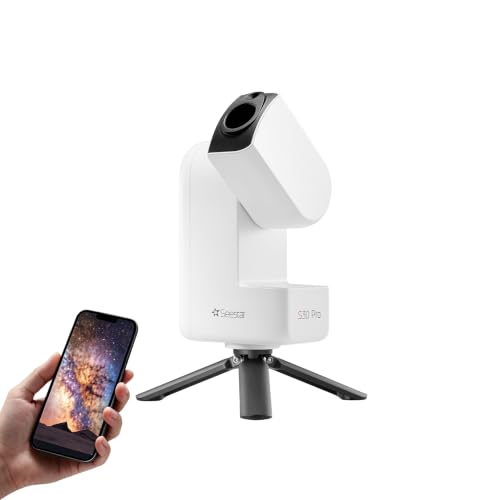 ZWO Seestar S30 Pro Smart Telescope
|
8.3/10 | Buy |
Frequently Asked Questions
What makes computerized GoTo mounts different from standard motorized tracking mounts?
GoTo mounts automatically locate and track objects, whereas basic motorized mounts only follow them once aligned manually. A GoTo system uses an internal database and onboard motors to slew the optical tube directly to coordinates you select in a hand controller or app. Basic motorized mounts simply turn at a steady sidereal rate to match Earth’s rotation. Selecting the best telescopes with automatic tracking usually gives you both automated target location and hands-free celestial following.
Can you use an automatic tracking telescope for deep-sky astrophotography?
Yes, but exposure times depend heavily on whether the mount operates in alt-azimuth or equatorial mode. Smart systems like the ZWO Seestar S30 Pro and DWARFLAB Dwarf Mini utilize integrated sensors and live stacking algorithms to counteract alt-azimuth field rotation. For long single exposures on traditional mounts, equatorial tracking is necessary to prevent star trails. Unlike manual reflectors detailed in an equatorial telescope review, smart alt-azimuth mounts rely on internal software stacking to capture sharp deep-sky nebulae.
Do automated telescopes work well in light-polluted urban backyards?
Yes, automated tracking models function very well in cities because their computerized alignment does not rely on spotting faint guide stars with the naked eye. Systems equipped with integrated light pollution filters isolate emission nebulae from city streetlights. Brighter targets like the Moon, Jupiter, and double stars remain clear regardless of urban skyglow. The motorized tracking keeps high-magnification planetary views centered without vibration.
How difficult is the initial star alignment on motorized GoTo telescopes?
Most modern tracking setups calibrate within three to five minutes using automated plate solving or simple three-star alignment. Systems like Celestron SkyAlign only require centering three bright sky objects without knowing their names. Newer smart telescopes use internal cameras and plate-solving algorithms to orient themselves automatically without any manual star centering. This eliminates the traditional frustration of reading complex sky charts in the dark.
Are smart telescopes with automatic tracking worth it compared to classic visual scopes?
Yes, smart telescopes offer unparalleled convenience for digital imaging, while classic visual scopes deliver real photons directly to your eye. Smart units stream stacked color images directly to a phone or tablet screen, revealing faint galactic arms that look like gray smudges through small manual eyepieces. However, traditional optical tubes provide an authentic visual connection that digital sensors cannot duplicate. While decorative brass scopes or classic models covered in a guide to nautical telescopes of 2026 emphasize optical styling, computerized tracking scopes prioritize active celestial imaging.
Is solar viewing safe with an automatic tracking telescope?
No, you must never point any telescope at the Sun without a certified front-aperture solar filter securely attached. Concentrated sunlight entering an unfiltered optical tube will instantly destroy digital imaging sensors and cause permanent blindness if viewed through an eyepiece. Smart telescopes designed for solar capture require specialized solar filters over the front objective lens before initiating solar tracking modes. Always inspect solar filters for pinholes or tears prior to alignment.
About the author

bsr_admin writes reviews and buying guides for BSP Review.