
Best Zoom Eyepieces for Telescopes of 2026 for Backyard Astronomy
Browse the best zoom eyepieces for telescopes of September 2026 to inspect lunar details and planets without swapping barrels in dark skies.
 By John Snow
Updated September 27, 2026
By John Snow
Updated September 27, 2026

Upgrade Magnification Without Swapping Barrels
Fumbling through an eyepiece case in the freezing dark can easily shake a lightweight mount and knock Jupiter or Saturn right out of your field of view. Swapping glass barrels between low-power locating and high-magnification planetary tracking interrupts dark adaptation and slows down your observing rhythm. Selecting the best zoom eyepieces for telescopes solves this persistent headache by letting you dial in focal lengths smoothly with a simple twist of a barrel collar. Based on optical specifications and user feedback, a dependable variable eyepiece helps you match your telescope’s optical tube focal ratio to changing atmospheric seeing conditions without disturbing your target. If you are pairing quality optics with capable telescopes for space, variable magnification keeps your optical alignment steady while hunting lunar rilles or deep-sky open clusters.
Optical coatings play an essential role when light passes through complex multi-element configurations. Many backyard stargazers prefer fully multi-coated elements because they reduce internal reflections and preserve lunar contrast across every step of the zoom range. A wide apparent field of view prevents that narrow tunnel effect that plagues cheaper visual accessories, while generous eye relief ensures eyeglass wearers can view comfortably. Careful evaluation of barrel sizes reveals that 1.25-inch and dual 2-inch fittings give observers flexible compatibility across various focusers. Whether you are studying detailed charts in telescopes books or scanning planetary discs from an urban balcony, adjustable visual focal lengths simplify visual astronomy.
| Award | Product | BSP Score About BSP ScoreThe BSP Score is our own rating from 0 to 10, based on performance, design and build, ease of use, and value. It reflects independent research and is never influenced by manufacturers, retailers, or affiliate commissions. Learn more › | |
|---|---|---|---|
| Best Overall |
SVBONY SV245 Zoom Eyepiece
|
8.9/10 | Buy |
| Best Budget |
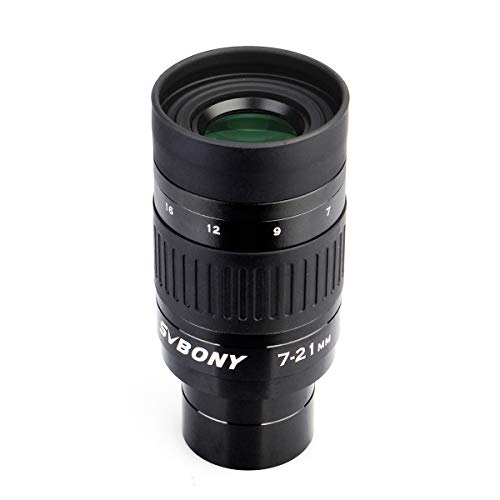 SVBONY SV135 Zoom Eyepiece
|
8.6/10 | Buy |
 Celestron 8-24mm Zoom Telescope Eyepiece
|
8.1/10 | Buy |
Frequently Asked Questions
Are zoom eyepieces parfocal across their entire focal range?
Mostly yes, though slight micro-focusing adjustments are sometimes required depending on your optical tube. Advanced models like the SVBONY SV245 utilize true parfocal engineering across their 8mm to 16mm range so you can zoom without losing focus. Cheaper designs might shift focus slightly when twisting between extreme focal lengths, but a tiny nudge on your telescope focuser restores sharpness instantly.
How does the apparent field of view change when zooming?
The apparent field of view typically narrows at longer focal lengths and widens at higher magnifications. An eyepiece spanning 7mm to 21mm often transitions from roughly 40 degrees at low power up to 57 degrees at maximum power. This optical behavior happens because internal lens groupings shift closer together, but higher power still yields plenty of lunar and planetary detail.
Can beginner astronomers use zoom eyepieces on budget telescopes?
Yes, zoom eyepieces provide excellent versatility on entry-level instruments. Instead of buying multiple individual Plössl lenses, beginner hobbyists using budget kids telescopes can explore multiple magnifications with one piece of glass. Standard 1.25-inch barrels drop into almost any entry-level focuser, making framing the Moon or bright planets straightforward for young stargazers.
Does a zoom eyepiece reduce image brightness compared to fixed lenses?
No noticeable light loss occurs for visual stargazing when premium optical coatings are present. While zoom models contain more internal optical elements, fully multi-coated surfaces prevent light scattering and ghosting. Planetary contrast remains crisp on instruments like Newtonian reflectors or refractors featured in our HSL 150EQ telescope review, allowing solid views of Saturn and Jupiter.
Can you attach standard 1.25-inch astronomy filters to a zoom eyepiece?
Yes, standard 1.25-inch zoom eyepieces feature threaded lower barrels for threaded astronomy filters. Observers can screw on neutral density Moon filters, light pollution filters, or planetary color filters right onto the barrel. This lets you switch focal lengths freely while keeping your filtration attached securely.
Is a zoom eyepiece suitable for daytime spotting and terrestrial viewing?
Yes, variable eyepieces work exceptionally well for daytime nature observation. Terrestrial viewers can survey distant scenery at low magnification before zooming into wildlife details without shaking the spotting scope mount. The wide focal range makes grab-and-go viewing effortless during both day and night sessions in 2026.
About the author

John Snow writes reviews and buying guides for BSP Review.