
Best Finder Scopes for Telescopes of 2026 for Stargazing Accuracy
Locate planets quickly with the best finder scopes for telescopes in September 2026. Improve alignment, reduce neck strain, and enjoy clear views.
 By Andrew McKean
Updated September 27, 2026
By Andrew McKean
Updated September 27, 2026

Aligning a primary optical tube assembly with a high-power eyepiece often feels like searching for a needle in a haystack. Shifting your neck at awkward angles in freezing night air just to spot a faint celestial target leads to frustration and wasted observing time. High magnification severely narrows your visual field, which makes manual star-hopping nearly impossible without an accurate aiming aid. Quality optical aiming tools solve this headache by bridging the gap between your naked-eye view and your main optics. That is why selecting the best finder scopes for telescopes is crucial for any backyard astronomy enthusiast who wants seamless target acquisition.
Evaluating the top aiming accessories requires a close look at objective lens diameter, optical coatings, reticle styles, and bracket mounting systems. Whether you prefer zero-magnification illuminated red dots or right-angle correct-image (RACI) configurations that save your neck from strain, proper gear keeps targets centered. Many observers pairing high-power barrels with dedicated telescopes for deep space observing rely on 8×50 or 9×50 finder units to pull faint star clusters out of light-polluted skies. Upgrading from a flimsy plastic bracket to a sturdy dovetail setup delivers rock-solid alignment stability, helping you spend less time hunting and more time enjoying the night sky.
| Award | Product | BSP Score About BSP ScoreThe BSP Score is our own rating from 0 to 10, based on performance, design and build, ease of use, and value. It reflects independent research and is never influenced by manufacturers, retailers, or affiliate commissions. Learn more › | |
|---|---|---|---|
| Best Overall |
Celestron StarPointer Red Dot Finderscope
|
8.9/10 | Buy |
| Best Budget |
 SVBONY Finder Scope, 5×24 Finderscope with Cross
|
8.8/10 | Buy |
| Best Value |
 SVBONY SV182 Finder Scope
|
8.8/10 | Buy |
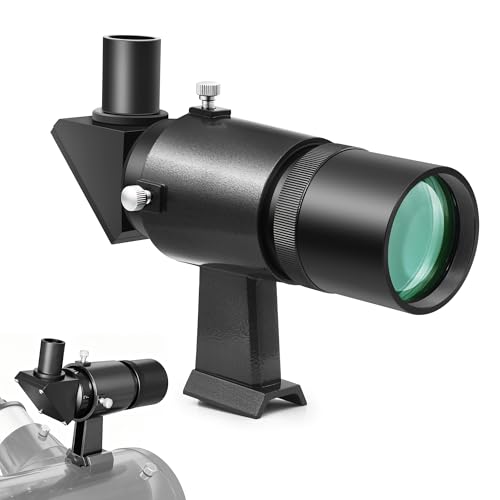 Astromania Finder Scope 9x50 Right Angle Optical
|
8.4/10 | Buy | |
| Best Premium |
 SVBONY SV208 Finder Scope 8x50 Finderscope
|
8.4/10 | Buy |
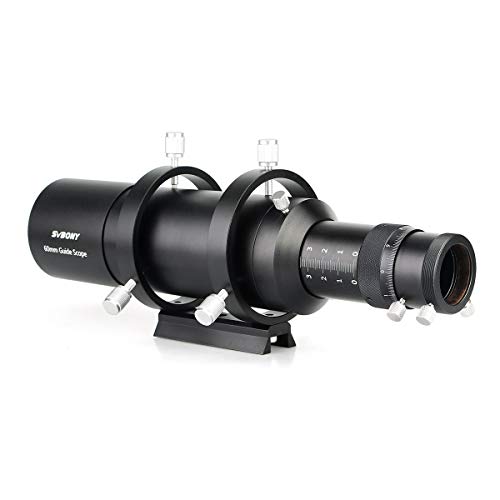 SVBONY SV106 Guide Scope Finder Scope 60mm,Helical
|
8.1/10 | Buy |
Frequently Asked Questions About Telescope Finders
What is the difference between a red dot finder and an optical finderscope?
A red dot finder offers unity 1x magnification with an illuminated LED point, while an optical finderscope uses curved lenses to magnify faint objects. Red dot sights like the Celestron StarPointer project an adjustable dot onto a clear glass window, keeping the sky right-side up for natural navigation. In contrast, magnified optical units gather more light through 30mm or 50mm objective lenses, revealing dimmer stars that remain invisible to the unaided eye. Red dots excel for bright planets, whereas optical models help locate deep-sky targets.
Why do observers prefer a right-angle correct-image finderscope?
Right-angle correct-image (RACI) finder scopes prevent neck strain by positioning the eyepiece at a ninety-degree angle relative to the tube. Standard straight-through finders force stargazers to contort their bodies when pointing near the zenith. RACI models, such as the SVBONY SV182 and Astromania 9×50, integrate an internal erecting prism to present views that match paper star charts and mobile astronomy applications. This design saves energy during extended observing sessions.
Can a guide scope double as a visual finder scope for telescopes?
Yes, versatile multi-use guide scopes can function as optical finders when paired with a standard 1.25-inch visual eyepiece. Models like the SVBONY SV106 60mm feature an integrated helical focuser and a compression ring that accepts visual eyepieces or dedicated autoguiding cameras. Inserting a standard 25mm eyepiece into the 60mm tube creates an effective 9.6x finder. This dual capability makes them highly attractive for amateur astronomers who alternate between visual stargazing and long-exposure astrophotography.
How does objective lens aperture impact finderscope performance in 2026?
Larger objective apertures significantly increase light-gathering capability, making faint stars and deep-sky objects visible within the crosshairs. A 50mm objective lens gathers substantially more light than a 24mm or 30mm optic, cutting through moderate suburban light pollution. While smaller finders keep your tube lightweight and portable, stepping up to an 8×50 or 9×50 model brings nebulae and star clusters into plain view before you switch to your main telescope eyepiece.
Is a 5×24 optical finder sufficient for beginner backyard astronomy?
A 5×24 finder provides an affordable entry point for centering the Moon and bright planets, but its small aperture limits deep-sky visibility. Many budget starter scopes ship with simple 5×24 units to keep manufacturing costs down. The narrow objective lens restricts light intake under suburban skies, making star-hopping to faint galaxies challenging. Upgrading to a larger optical aperture or an illuminated red dot sight often delivers a much better locating experience.
What makes an illuminated glass reticle helpful during night observations?
Illuminated reticles prevent black crosshairs from vanishing against dark skies or dim nebular backgrounds. Units like the SVBONY SV208 incorporate an adjustable red LED illuminator that softly highlights the crosshair without ruining your dark-adapted night vision. Laser-etched glass reticles also provide mechanical stability, resisting misalignments if bumped during transport or cold nighttime setup sessions.
About the author

Andrew McKean is an experienced outdoor journalist and optics specialist with extensive experience evaluating binoculars, spotting scopes, and other outdoor optical equipment. His work combines practical field testing with detailed technical analysis, helping readers understand optical performance, durability, and the features that matter when comparing equipment.