Best Telescopes for Backyard Astronomy of 2026: Stargazer Picks
Best Telescopes For Backyard Astronomy guide for September 2026: evaluate optical aperture and stable mounts to view bright planets and deep-sky nebulae clearly.
 By bsr_admin
Updated September 27, 2026
By bsr_admin
Updated September 27, 2026
Steady Mounts and Crisp Optics for Backyard Stargazing
Few things ruin an evening under the stars faster than a shaky tripod that shivers every time you touch the focuser. When magnification pushes past realistic limits, planets turn into murky blurs while purple fringing bleeds across the lunar limb. Selecting the best telescopes for backyard astronomy means looking past inflated magnification numbers and focusing on solid mounts, generous clear aperture, and sharp optical glass. Whether you lean toward lightweight refractor tubes or light-gathering Newtonian reflectors, balancing portability against optical performance keeps stargazing fun rather than stressful. If you want a setup for curious youngsters, exploring budget-friendly starter telescopes can help set practical expectations without breaking the bank.
Optical specifications tell you far more than marketing buzzwords. Based on optical specifications and user feedback, aperture diameter directly dictates how much light reaches your eye when observing faint clusters or lunar details. Achromatic refractors with 70mm to 90mm lenses provide grab-and-go ease, while larger designs like manual equatorial reflectors pull in dimmer deep-sky targets. Remember to never point any optical tube toward the Sun without certified front-aperture solar filters, as unfiltered sunlight causes immediate and permanent eye injury. With a dependable optical tube assembly and a steady base, your backyard transforms into a personal window to the cosmos.
| Award | Product | BSP Score About BSP ScoreThe BSP Score is our own rating from 0 to 10, based on performance, design and build, ease of use, and value. It reflects independent research and is never influenced by manufacturers, retailers, or affiliate commissions. Learn more › | |
|---|---|---|---|
| Best Overall |
 90mm Telescope for Adults High Powered
|
9.2/10 | Buy |
| Best Budget |
 Koolpte Telescope for Adults & Beginner
|
8.6/10 | Buy |
| Best Value |
 Gskyer Telescope, 70mm Aperture 400mm AZ Mount
|
8.4/10 | Buy |
| Best Premium |
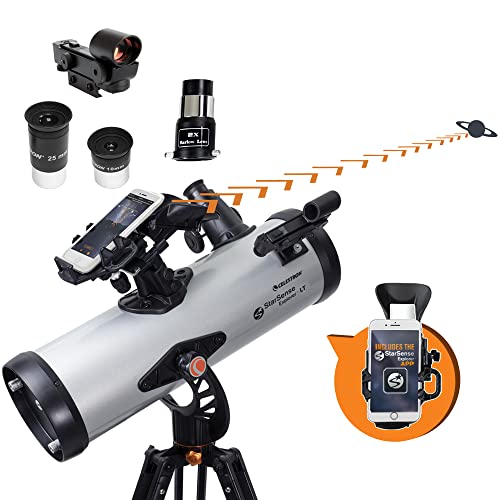 Celestron StarSense Explorer LT 114AZ Newtonian
|
8.4/10 | Buy |
 Telescope for Adults & Kids
|
8.1/10 | Buy | |
 Celestron AstroMaster 130EQ Telescope for Deep-Sky
|
8.0/10 | Buy |
Frequently Asked Questions
What optical feature matters most in best telescopes for backyard astronomy?
Clear optical aperture is the single most critical factor when selecting a telescope. Measured in millimeters, aperture dictates how much light enters the optical tube, determining image brightness and detail resolution. Magnification means little without sufficient light gathering, as pushing power too high on a small lens produces dark, blurry images. An aperture between 70mm and 130mm offers great performance for lunar and planetary viewing.
Should beginners choose a refractor or a Newtonian reflector?
Achromatic refractors are generally easier for absolute beginners because their closed optical tubes require zero optical collimation and virtually no maintenance. They deliver crisp, high-contrast lunar views right out of the box. Newtonian reflectors provide larger aperture per dollar, pulling in dimmer star clusters and nebulae, though they require occasional mirror alignment. If you prefer grab-and-go simplicity, a refractor remains the hassle-free choice.
Can you view planets clearly from a light-polluted suburban backyard?
Yes, bright planets like Jupiter, Saturn, and Venus cut through suburban light pollution easily. Planetary contrast depends on steady atmospheric conditions rather than completely dark skies. While city glow dims faint galaxies, a stable mount and quality eyepieces reveal Jupiter’s cloud belts, the rings of Saturn, and lunar craters from your patio. Using practical stargazing reference books helps you locate these bright celestial targets throughout 2026.
How does an alt-azimuth mount differ from an equatorial mount?
An alt-azimuth mount moves up-and-down and left-to-right, functioning just like a standard camera tripod for quick, intuitive aiming. Equatorial mounts feature an axis aligned with Earth’s polar tilt, allowing you to track objects smoothly across the sky using a single slow-motion control knob. While equatorial mounts involve a slight learning curve, they make keeping planets centered at high magnification much simpler.
Is a 3x Barlow lens necessary for beginner stargazing?
No, a 3x Barlow lens is not strictly necessary, but it triples the magnification of your existing eyepieces. Barlows offer versatile power options, yet pushing magnification beyond roughly 50x per inch of aperture degrades image sharpness. When paired with a wide 25mm eyepiece, a Barlow provides comfortable, high-contrast lunar views without forcing your eye uncomfortably close to tiny lens elements.
About the author

bsr_admin writes reviews and buying guides for BSP Review.