Best Telescopes to View Mars of 2026 for Sharp Views
Best Telescopes To View Mars guide for September 2026 reveals top optical tubes with steady mounts and clear planetary contrast for observing the Red Planet.
 By Andrew McKean
Updated September 27, 2026
By Andrew McKean
Updated September 27, 2026

Observing the Red Planet through an entry-level optical tube often frustrates beginners expecting clear surface channels but encountering a tiny, vibrating orange speck. Mars presents a unique planetary challenge because its modest apparent size requires genuine optical resolution, steady atmospheric seeing, and a vibration-free mount at high magnification. Selecting the best telescopes to view mars requires balancing optical aperture with realistic focal limits to resolve dark albedo surface markings and polar ice caps. Compact refractors deliver quick grab-and-go convenience, but a five-inch reflector gathers enough light to sustain contrast past one hundred times magnification.
Mount stability dictates your success, as slight vibrations easily throw high-power targets outside the field of view. Sturdy alt-azimuth tripods with slow-motion cables or smooth tabletop Dobsonian bases ensure seamless manual tracking as celestial objects drift. Reviewing optical specifications, mirror coatings, and included eyepieces helps separate capable planetary scopes from toy-grade optics. Observers wanting broader exploration beyond the solar system can check our guide on telescopes for deep space targets to balance planetary contrast with wide-field views.
| Award | Product | BSP Score About BSP ScoreThe BSP Score is our own rating from 0 to 10, based on performance, design and build, ease of use, and value. It reflects independent research and is never influenced by manufacturers, retailers, or affiliate commissions. Learn more › | |
|---|---|---|---|
| Best Overall |
Sky-Watcher Sky-Watcher Heritage 130mm Tabletop
|
8.9/10 | Buy |
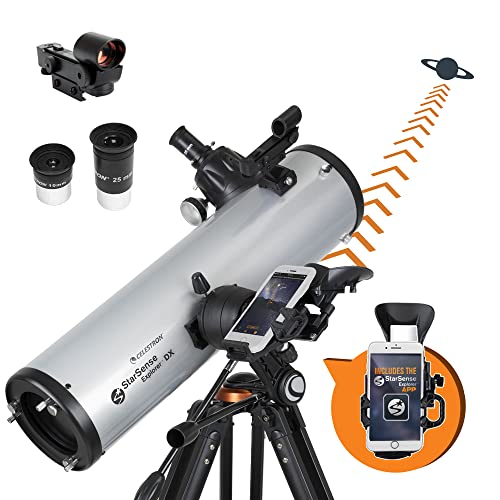 Celestron StarSense Explorer DX 130AZ Smartphone
|
8.3/10 | Buy | |
| Best Budget |
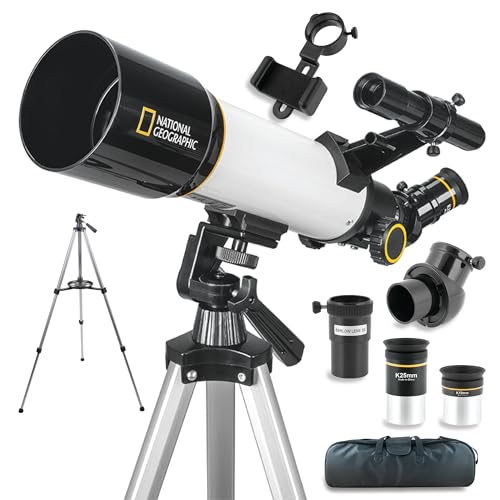 National Geographic Sky View 70mm Refractor
|
8.0/10 | Buy |
Frequently Asked Questions
What minimum aperture is needed to see Martian surface details?
At least 100mm to 130mm (4 to 5 inches) of clear aperture is recommended for resolving dark surface features on Mars. Smaller 70mm refractors easily reveal the planetary disk and orange color, but distinguishing polar ice caps and subtle maria requires the superior light grasp of a larger mirror.
Can you observe Mars effectively under suburban light pollution?
Yes, suburban light pollution has virtually no negative effect on planetary observation because Mars is exceptionally bright. City skyglow washes out faint nebulae, but planetary contrast depends primarily on atmospheric stability rather than dark skies. Setting up on grass instead of heat-retaining concrete helps stabilize your views.
How does a Barlow lens help with the Best Telescopes To View Mars?
A Barlow lens doubles or triples the focal length of your optical system, providing higher magnification with your existing eyepieces. Because Mars appears very small in the night sky, pairing a 10mm eyepiece with a quality Barlow yields the high power needed to expand the Martian disk.
Why does Mars sometimes appear as a blurry orange blob?
Unstable atmospheric seeing, warm telescope optics, or pushed magnification limits are the primary causes of blurry planetary images. Telescope mirrors need thirty minutes to cool to outdoor temperatures, and pushing past twice your aperture in millimeters results in empty magnification. Observing when Mars climbs high above the horizon sharpens focus.
Reflector or refractor: which optical design suits Mars better?
Newtonian reflectors deliver larger aperture and sharper planetary resolution at a much lower price point. While refractors eliminate collimation adjustments and provide durable grab-and-go use, compact budget models can produce chromatic aberration around bright targets. Stargazers weighing beginner setups can inspect budget telescopes for beginners and kids before stepping up to a 130mm parabolic reflector.
About the author

Andrew McKean is an experienced outdoor journalist and optics specialist with extensive experience evaluating binoculars, spotting scopes, and other outdoor optical equipment. His work combines practical field testing with detailed technical analysis, helping readers understand optical performance, durability, and the features that matter when comparing equipment.