Best Telescopes Under 250 of 2026 Stargazer Picks
Top best telescopes under 250 in September 2026 offer smartphone sky guidance, crisp lunar views, and easy alt-azimuth tracking for beginner stargazers.
 By bsr_admin
Updated September 27, 2026
By bsr_admin
Updated September 27, 2026
Navigating Backyard Skies on a Budget
Flimsy plastic finderscopes and wobbly mounts turn what should be an exciting night under the stars into an exercise in frustration. Pointing an optical tube assembly at a faint smudge of light only to lose it the second your hand leaves the focuser is a common headache for new sky watchers. Targeting the best telescopes under 250 means balancing clear optical aperture against rock-solid mechanical reliability, so you spend your evenings enjoying lunar craters rather than wrestling with alignment. If you are also researching options for younger family members, exploring budget-friendly youth scopes can provide useful context on how entry-level mechanical designs compare.
Aperture remains key when pulling faint nebulae out of suburban skyglow. While refractors like the Celestron StarSense Explorer LT 80AZ Smartphone offer low-maintenance glass optics with zero collimation needs, Newtonian reflectors like the Celestron StarSense Explorer LT 114AZ Newtonian step up light gathering with their 4.5-inch primary mirrors. Both models tackle the classic star-hopping challenge by using smartphone plate-solving technology to guide your manual tracking, giving you high-tech assistance without the battery drain or gear complexity of motorized GoTo mounts.
| Award | Product | BSP Score About BSP ScoreThe BSP Score is our own rating from 0 to 10, based on performance, design and build, ease of use, and value. It reflects independent research and is never influenced by manufacturers, retailers, or affiliate commissions. Learn more › | |
|---|---|---|---|
| Best Overall |
 Celestron StarSense Explorer LT 80AZ Smartphone
|
9.2/10 | Buy |
| Best Value |
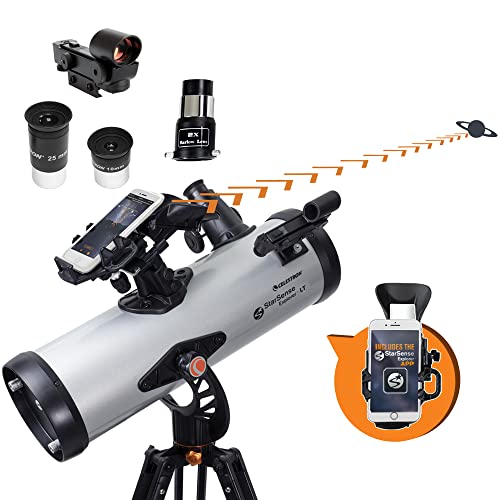 Celestron StarSense Explorer LT 114AZ Newtonian
|
8.4/10 | Buy |
Frequently Asked Questions
Can the best telescopes under 250 show the rings of Saturn and cloud belts on Jupiter?
Yes, both an 80mm refractor and a 114mm reflector easily reveal Saturn’s rings and Jupiter’s major atmospheric bands. At this optical tier, focal lengths typically range around 900mm to 1000mm, delivering sufficient focal ratio and resolving power for high-contrast planetary viewing. You can also spot Jupiter’s four bright Galilean moons as distinct pinpoint dots of light on steady nights.
What is the difference between an 80mm refractor and a 114mm reflector?
Optical layout and routine maintenance mark the main distinction between these two configurations. Refractors use front glass lenses inside a sealed tube, meaning they stay protected from dust and never require optical mirror adjustment. Newtonian reflectors use mirrors to provide wider aperture per dollar, though they may occasionally need optical collimation to maintain pinpoint focus. For those curious about larger equatorial setups, checking our equatorial reflector telescope reviews offers helpful perspective on mount mechanics.
How does smartphone sky guidance work on manual alt-azimuth mounts in 2026?
Smartphone plate-solving software analyzes overhead star patterns through your phone camera to calculate telescope orientation in real time. Systems like StarSense Explorer guide you with on-screen directional arrows until a bullseye turns green over your selected celestial target. This approach bypasses complicated multi-star alignments while keeping the telescope lightweight and battery-free.
Can you capture astrophotography images with these telescopes?
Basic lunar and bright planetary photography is achievable, but long-exposure deep-sky astrophotography is not supported. Manual alt-azimuth mounts lack motorized sidereal tracking, which causes star streaks in exposures longer than a fraction of a second. However, pairing your smartphone with a digiscoping eyepiece adapter yields sharp snapshots of lunar craters. Consulting practical observing guides can help you plan the best nights for lunar photography.
Is it safe to view the Sun through these entry-level telescopes?
No, never look at the Sun through an optical telescope without an ISO-certified, front-aperture solar filter securely attached. Pointing an unfiltered telescope at the Sun focuses intense heat directly onto your retina, causing instant and irreversible eye damage. Eyepieces and optical finderscopes must stay completely shielded from direct sunlight at all times.
About the author

bsr_admin writes reviews and buying guides for BSP Review.