Best Equatorial Telescope Mounts for Beginners of 2026 for Steady Tracking
Track celestial targets with the Best Equatorial Telescope Mounts For Beginners of 2026. Updated for September 2026 with stable, balanced optics.
 By bsr_admin
Updated September 27, 2026
By bsr_admin
Updated September 27, 2026
Mastering Night Sky Tracking Without Endless Shaking
Watching Saturn slide out of view every fifteen seconds at high magnification quickly tests any stargazer’s patience. Standard alt-azimuth tripods force you to nudge two axes at once, creating jittery images that ruin high-power planetary observing. Setting up one of the best equatorial telescope mounts for beginners solves this headache by aligning with the rotational axis of Earth, so a single turn of a slow-motion cable keeps your target centered in the field of view. Our analysis of mount mechanics, worm gears, and counterweight payloads shows that a rigid equatorial head turns frustrating drift into smooth, uninterrupted lunar and planetary sessions. You can also pair these setups with telescope finder scopes for quick star alignment to acquire celestial coordinates before you start tracking.
Flimsy aluminum legs and uneven balance often lead to vibrations that make focusing nearly impossible under dark skies. Solid equatorial systems rely on heavy-duty counterweights, precision right ascension dials, and dampening tripods to absorb physical contact during long backyard observations. Pairing an optical tube assembly with smooth declination controls and durable worm drives gives novice astronomers steady images without unwanted wobbles. These reliable mechanical platforms provide the steady tracking you need for exploring bright nebulae, lunar craters, and deep-sky wonders without losing your alignment.
| Award | Product | BSP Score About BSP ScoreThe BSP Score is our own rating from 0 to 10, based on performance, design and build, ease of use, and value. It reflects independent research and is never influenced by manufacturers, retailers, or affiliate commissions. Learn more › | |
|---|---|---|---|
| Best Overall |
 iEXOS-100-2 PMC-Eight Equatorial Tracker System
|
8.8/10 | Buy |
| Best Budget |
 Koolpte Telescope for Adults & Beginner
|
8.6/10 | Buy |
| Best Premium |
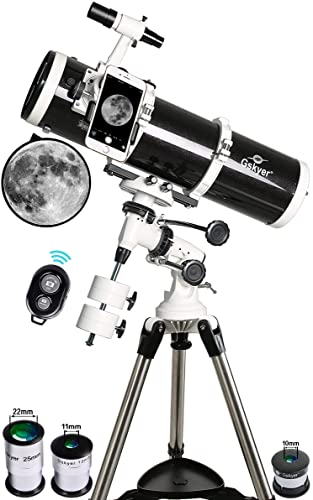 Gskyer 130EQ Professional Astronomical Reflector
|
8.6/10 | Buy |
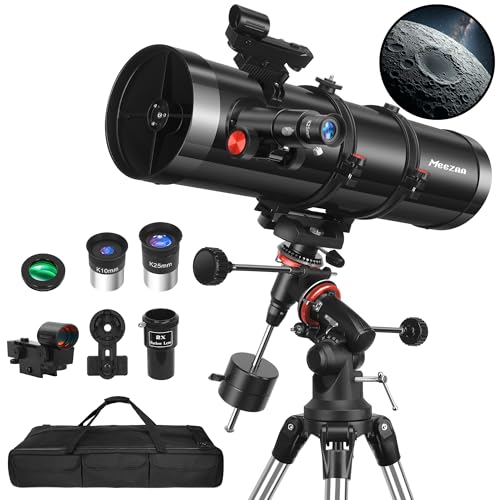 MEEZAA Telescope, 150EQ Newtonian Reflector
|
8.1/10 | Buy | |
 Celestron AstroMaster 130EQ Telescope for Deep-Sky
|
8.0/10 | Buy |
Frequently Asked Questions
What makes an equatorial mount better than an alt-azimuth mount for beginners?
A single-axis tracking design makes the primary difference. Alt-azimuth heads require constant adjustments along both altitude and azimuth axes to follow celestial bodies. German equatorial mounts align directly with the celestial pole, allowing observers to track stars, planets, and deep-sky targets by turning just the right ascension slow-motion cable.
Do Best Equatorial Telescope Mounts For Beginners require precise polar alignment for visual stargazing?
No, visual stargazing only requires a rough polar alignment toward Polaris in the northern hemisphere. Precise drift alignment or polar scope calibration is mainly necessary for long-exposure astrophotography. For casual visual observing of the Moon and planets, pointing the polar axis roughly north at your local latitude angle provides steady manual tracking.
Can beginners use an equatorial mount for astrophotography in 2026?
Yes, beginner equatorial mounts like motorized tracker systems support short-exposure planetary imaging and wide-field night sky photography. Motorized right ascension drives counteract the rotation of Earth to eliminate star trailing. Observers wanting to explore celestial photography can reference dedicated astronomy books for clear lunar views to master exposure settings and target selection.
How much counterweight is required for an equatorial telescope mount?
The counterweight must exactly balance the total weight of your optical tube assembly and accessories. An unbalanced telescope strains worm gears, increases vibration settling time, and causes slipping along the declination axis. Sliding the counterweight along the shaft until the unlocked optical tube remains stationary in any position ensures smooth manual movement.
Why do optical tube eyepieces rotate into awkward positions on an equatorial mount?
Eyepieces rotate because the optical tube tilts along both polar and declination axes as it tracks celestial targets across the sky. Newtonian reflectors are particularly prone to this awkward eyepiece orientation during meridian flips. Loosening the tube mounting rings slightly allows you to rotate the focuser to a comfortable viewing angle before tightening the rings down again.
About the author

bsr_admin writes reviews and buying guides for BSP Review.