Best Telescopes for Beginner Astrophotography of 2026 for Clear Night Sky Imaging
Capture sharp lunar craters and nebulae in September 2026 with the best telescopes for beginner astrophotography built for steady tracking.
 By bsr_admin
Updated September 27, 2026
By bsr_admin
Updated September 27, 2026
Vibrations from lightweight tripods and blurry star trails often ruin the excitement of capturing your first night sky image. Long exposure photography magnifies every mechanical wobble, transforming bright stars into distorted streaks rather than pinpoint highlights. Selecting the best telescopes for beginner astrophotography requires balancing generous optical aperture, manageable focal ratios, and stable mounts that track celestial targets smoothly across the sky. Whether you want to photograph lunar craters with a smartphone adapter or capture deep-sky nebulae with integrated smart sensors, optical clarity and tracking stability make all the difference.
Apochromatic refractors and compact reflectors with fully multi-coated optics help suppress chromatic aberration, keeping planetary edges clean and contrast high. Manual systems like those featured in our look at equatorial reflector telescopes teach celestial mechanics, while smart automated optics handle star alignment autonomously. Evaluating aperture size, focal length, and mount dampening allows new imagers to avoid blurry photos and enjoy rewarding night sky captures right from the backyard.
| Award | Product | BSP Score About BSP ScoreThe BSP Score is our own rating from 0 to 10, based on performance, design and build, ease of use, and value. It reflects independent research and is never influenced by manufacturers, retailers, or affiliate commissions. Learn more › | |
|---|---|---|---|
| Best Overall |
 90mm Telescope for Adults High Powered
|
9.2/10 | Buy |
| Best Budget |
 Gskyer Telescope, 70mm Aperture 400mm AZ Mount
|
8.4/10 | Buy |
| Best Premium |
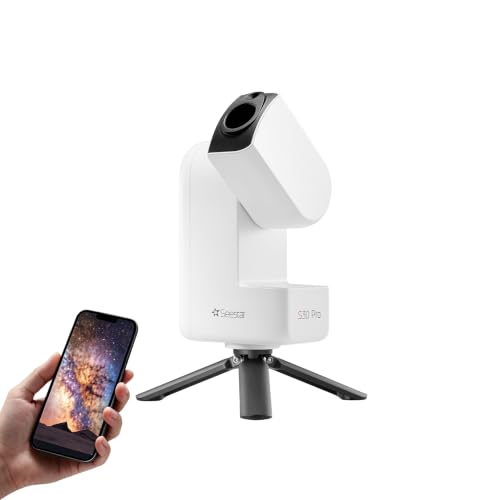 ZWO Seestar S30 Pro Smart Telescope
|
8.3/10 | Buy |
 Telescope for Adults & Kids
|
8.1/10 | Buy | |
 Celestron AstroMaster 130EQ Telescope for Deep-Sky
|
8.0/10 | Buy |
Frequently Asked Questions
Can you do astrophotography with an alt-azimuth mount?
Yes, but alt-azimuth mounts are primarily limited to short exposures of the Moon and bright planets. Field rotation blurs deep-sky exposures that exceed twenty to thirty seconds because alt-azimuth mounts move up-down and left-right instead of matching Earth’s rotational axis. Smart telescopes solve this hurdle through automated live stacking of brief exposures, making them effective for entry-level deep-sky imaging.
What aperture size is recommended for beginner astrophotography?
An optical aperture between 70mm and 130mm is ideal for beginners entering astrophotography in 2026. Moderate apertures gather ample light for nebulae and lunar ridges while remaining light enough to sit securely on portable tripods. Larger apertures capture dimmer details, but excessive optical tube weight often introduces mount instability and vibrations.
Refractor or reflector: which is better for beginner astrophotography?
Compact refractors are generally easier for beginners because they require zero optical collimation and provide sharp, sealed optical paths. Newtonian reflectors offer more aperture per dollar, though their mirrors require regular optical alignment. Stargazers browsing budget starter telescopes often prefer refractors for quick backyard setups, whereas reflectors deliver superior light gathering for faint galaxies.
How does focal ratio affect exposure times in astrophotography?
Faster focal ratios between f/4 and f/6 dramatically reduce the exposure time needed to capture faint nebulae and star clusters. A fast optical system gathers photons onto the sensor more quickly than a slow f/10 or f/12 system. Selecting fast optics within the best telescopes for beginner astrophotography category allows beginners to capture bright exposures before tracking drift blurs the frame.
Can you photograph deep-sky objects from light-polluted suburban skies?
Yes, modern imaging filters and smart sensor stacking allow beginners to capture bright deep-sky objects even under Bortle class 6 to 8 skies. Light pollution filters isolate hydrogen-alpha and oxygen-III wavelengths, cutting through artificial city glow. Pairing filtered optics with helpful stargazing reference books helps you locate the highest-contrast targets observable from your backyard.
Is a smartphone adapter sufficient for beginner astrophotography?
Yes, a smartphone adapter paired with a steady eyepiece provides an affordable entry point for lunar and planetary imaging. Digiscoping clamps hold your phone camera directly over the eyepiece lens to record bright crater details and planetary discs. Taking deep-sky images of faint nebulae, however, eventually requires dedicated astronomy sensors or smart optical systems with long-exposure tracking.
About the author

bsr_admin writes reviews and buying guides for BSP Review.