Best Smart Phone Telescopes of 2026 for Clear Stargazing
Best Smart Phone Telescopes picks for September 2026: compare app-guided optics, aperture specs, and steady mounts for clear lunar and planetary stargazing.
 By bsr_admin
Updated September 27, 2026
By bsr_admin
Updated September 27, 2026
Overcoming Alignment Headaches Under Suburban Skies
Uncalibrated finderscopes and confusing star charts often turn an evening of backyard observation into an exercise in frustration. Fighting a slipping mount while squinting at dim gray smudges makes locating deep-sky targets difficult. Modern smartphone integration solves this by turning your phone into an interactive celestial guide that points your optical tube toward bright planets and distant nebulae. Investing in the best smart phone telescopes helps stargazers bypass tedious manual alignment while preserving clear views of lunar craters and planetary rings. Whether you want family stargazing gear or want to explore starter telescopes for youth, app-guided tracking keeps night sky exploration fun.
Selecting the right instrument requires balancing optical aperture against mount stability, since tripod shakes quickly ruin views at high magnification. Based on our analysis of aperture dimensions and optical coatings, models like the Celestron StarSense Explorer lineup and Gskyer refractor kits pair sturdy phone brackets with capable glass. A 130mm reflector gathers ample light for faint nebulae, while compact 70mm refractors require zero thermal cooldown delay and suit small balconies. Remember that daytime solar observation demands a certified front-aperture solar filter to prevent permanent eye injury. Checking focuser diameter and slow-motion controls ensures your setup performs smoothly on clear nights.
| Award | Product | BSP Score About BSP ScoreThe BSP Score is our own rating from 0 to 10, based on performance, design and build, ease of use, and value. It reflects independent research and is never influenced by manufacturers, retailers, or affiliate commissions. Learn more › | |
|---|---|---|---|
| Best Overall |
 Celestron StarSense Explorer LT 80AZ Smartphone
|
9.2/10 | Buy |
| Best Premium |
 Celestron StarSense Explorer DX 5" App-Enabled
|
8.6/10 | Buy |
| Best Budget |
 Gskyer Telescope, 70mm Aperture 400mm AZ Mount
|
8.4/10 | Buy |
| Best Value |
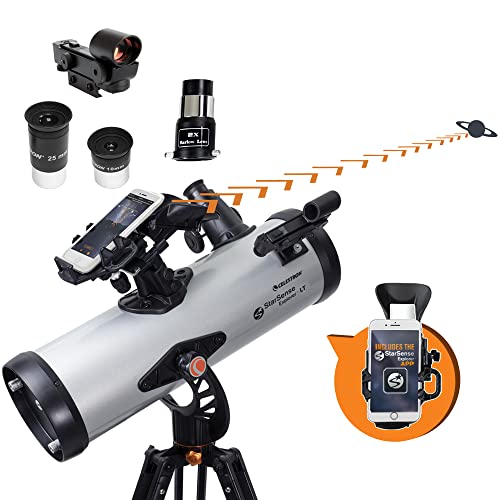 Celestron StarSense Explorer LT 114AZ Newtonian
|
8.4/10 | Buy |
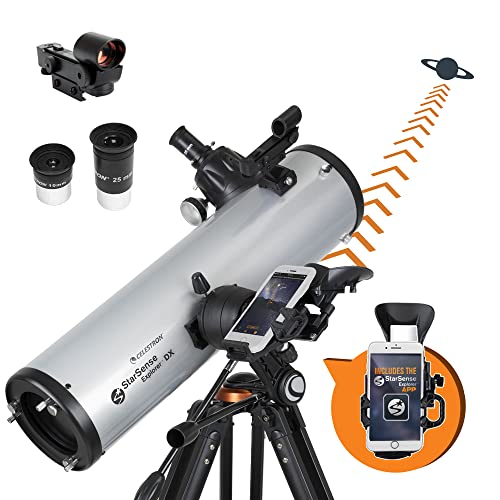 Celestron StarSense Explorer DX 130AZ Smartphone
|
8.3/10 | Buy |
Frequently Asked Questions
How do smartphone-guided systems locate celestial objects?
Smartphone-guided telescopes use specialized mirror brackets and plate-solving technology to calculate your exact sky position. The mobile application captures star patterns overhead through your phone camera and matches them against an internal database. Once calibrated, on-screen directional arrows steer your manual mount directly toward planets, star clusters, or nebulae without requiring motorized tracking motors.
Can you see deep-sky objects with best smart phone telescopes from light-polluted suburbs?
Yes, moderate light pollution permits clear views of bright deep-sky targets when using at least 100mm to 130mm of optical aperture. Instruments like the Celestron StarSense Explorer DX 130AZ collect ample light to reveal the Orion Nebula, Andromeda Galaxy, and bright star clusters. Observers under high Bortle scale skies may find studying detailed telescope guidebooks helpful for identifying high-contrast objects on any given night.
What is the difference between refractor and reflector models in this category?
Refractors use sealed glass lenses that require zero optical maintenance, while reflectors utilize mirrors that provide larger aperture diameters per dollar. An 80mm refractor yields crisp contrast on the Moon without alignment chores, whereas a 114mm or 130mm Newtonian reflector gathers substantially more light for faint galaxies. For stargazers deciding between manual alt-azimuth platforms and complex equatorial reflector designs, alt-azimuth app mounts offer much faster backyard setup.
Do these smartphone telescope setups support astrophotography?
No, these manual alt-azimuth systems are primarily engineered for visual stargazing and basic lunar snapshots. While included phone adapters and wireless remotes let you photograph bright targets like the Moon, long-exposure deep-sky photography is impossible without motorized equatorial tracking. Basic smartphone digiscoping captures sharp craters and Jupiter’s major moons, but faint nebulae require specialized tracking mounts.
Is optical collimation necessary for Newtonian app-guided telescopes?
Yes, Newtonian reflectors periodically require primary and secondary mirror alignment to maintain pinpoint star images. Optical collimation ensures incoming light converges accurately at the eyepiece focal plane, preventing distorted or blurry stars. Refractor alternatives like the 70mm or 80mm designs avoid this step entirely because their factory-aligned objective lenses stay permanently fixed in the optical tube.
Can you view the Sun with best smart phone telescopes during daytime?
No, you must never look directly at the Sun through any telescope without a certified front-aperture solar filter. Focusing unfiltered sunlight through an optical tube assembly causes instantaneous, permanent blindness and severe equipment damage. Solar observing requires ISO-certified filters placed securely over the front lens before pointing anywhere near the Sun.
About the author

bsr_admin writes reviews and buying guides for BSP Review.