Best Telescopes Under 400 of 2026 For Clear Sky Views
Best Telescopes Under 400 options for September 2026 deliver bright optical apertures, steady tracking mounts, and crisp views of lunar craters.
 By bsr_admin
Updated September 27, 2026
By bsr_admin
Updated September 27, 2026
Stargazing Without Wobbly Mounts and Blurry Optics
Vibrations from flimsy aluminum tripods often ruin an otherwise clear night of lunar observation by turning Saturn into a jittery blur. Many entry-level stargazers struggle with mounts that wobble at the slightest touch or focusers that refuse to hold a crisp image. Sifting through technical specifications reveals that the best telescopes under 400 deliver reliable parabolic primary mirrors and stable bases without breaking your astronomy budget. Solid optical performance relies heavily on generous light-gathering aperture, whether you prefer an alt-azimuth tabletop design or a manual German equatorial setup.
Careful evaluation of optical tube designs, focal ratios, and eyepiece selections helps separate capable reflectors from disappointing plastic department-store scopes. A fast f/5 focal ratio combined with a five-inch or six-inch mirror provides wide, bright fields of view for sweeping across star clusters and faint nebulae. If you want to introduce younger family members to the night sky, pairing these optical tubes with resources like introductory stargazing scopes for beginners makes celestial navigation far more rewarding. Keeping expectations grounded around practical magnification limits ensures you enjoy razor-sharp lunar craters rather than empty, dim magnifications.
| Award | Product | BSP Score About BSP ScoreThe BSP Score is our own rating from 0 to 10, based on performance, design and build, ease of use, and value. It reflects independent research and is never influenced by manufacturers, retailers, or affiliate commissions. Learn more › | |
|---|---|---|---|
| Best Overall |
 Sky-Watcher Sky-Watcher Heritage 130mm Tabletop
|
8.9/10 | Buy |
| Best Value |
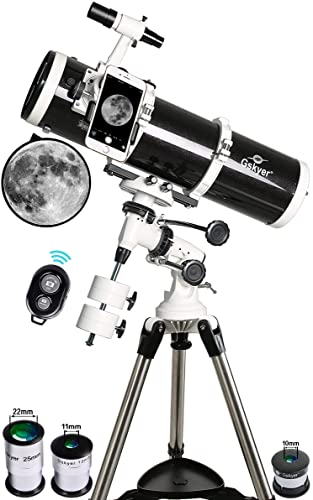 Gskyer 130EQ Professional Astronomical Reflector
|
8.6/10 | Buy |
| Best Premium |
 Sky-Watcher Heritage 150 Tabletop Dobsonian
|
8.1/10 | Buy |
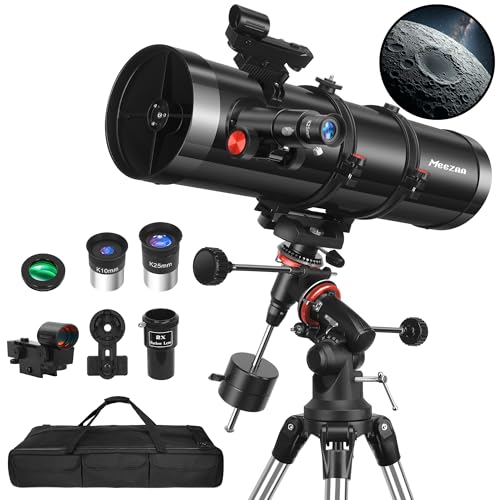 MEEZAA Telescope, 150EQ Newtonian Reflector
|
8.1/10 | Buy | |
| Best Budget |
 Celestron AstroMaster 130EQ Telescope for Deep-Sky
|
8.0/10 | Buy |
Frequently Asked Questions
Can the Best Telescopes Under 400 show Saturn’s rings and Jupiter’s cloud belts?
Yes, 130mm and 150mm parabolic reflectors gather enough light to resolve Saturn’s iconic ring system and the prominent atmospheric bands across Jupiter. Using a 10mm eyepiece or adding a Barlow lens pushes the focal length into suitable planetary magnification without sacrificing brightness. Crisp atmospheric conditions yield views of Jupiter’s four Galilean moons as distinct pinpoint disks.
Are tabletop Dobsonian mounts steadier than equatorial tripods under $400?
Yes, tabletop Dobsonian designs offer superior vibration dampening compared to lightweight aluminum equatorial tripods in this price category. The low center of gravity and smooth Teflon-style altitude and azimuth bearings allow effortless manual nudging without oscillating back and forth. You only need a firm picnic table or stable platform to enjoy shake-free stargazing.
How difficult is optical collimation for a beginner using a Newtonian reflector?
Aligning the primary and secondary mirrors takes only five to ten minutes once you understand the adjustment screws. Collapsible truss and solid-tube reflectors hold mirror alignment reasonably well during standard transport. A simple collimation cap or Cheshire eyepiece lets you center the optical reflections quickly before nighttime observing sessions.
What deep-sky objects can you observe under suburban light pollution?
Bright emission nebulae like the Orion Nebula (M42), the Andromeda Galaxy (M31), and dense globular clusters like Hercules (M13) remain accessible under moderate suburban skies. A five-inch or six-inch optical aperture cuts through city glow far better than smaller department-store refractors. Pairing your optical tube with practical astronomy guidebooks helps you identify suitable deep-space targets despite ambient neighborhood lighting.
Can you capture astrophotography with the Best Telescopes Under 400?
Basic lunar and planetary photography works well using a smartphone digiscoping adapter and a Bluetooth camera shutter. Manual alt-azimuth and equatorial mounts in this tier do not support long-exposure deep-sky imaging because Earth rotation quickly causes star trails. High-speed video capture of the Moon or bright planets remains the ideal photographic starting point for beginners.
Can you safely observe the Sun with these reflector telescopes?
No, you must never point a telescope toward the Sun without a certified, securely fitted front-aperture solar filter. Focusing direct sunlight through an unfiltered optical tube will destroy your eyesight permanently and melt internal telescope hardware within seconds. Eyepiece-mounted solar filters are extremely dangerous and must never be used under any circumstances.
About the author

bsr_admin writes reviews and buying guides for BSP Review.